DoubleTick vs Wati: Which WhatsApp API Tool Is Better?
DoubleTick and Wati solve the same problem in different ways. We compare both honestly — and show where an all-in-one platform like SabNode fits if you need more than WhatsApp.
DoubleTick and Wati are both WhatsApp Business API platforms built for Indian businesses, but they're optimized for different jobs: DoubleTick is built around high-volume broadcast and per-agent sales workflows for outbound-heavy SMB sales teams, while Wati is a broader platform with a deeper chatbot/flow builder, shared inbox and wider integration ecosystem aimed at general customer engagement. Neither is objectively "better" — DoubleTick tends to win for sales teams doing bulk outreach with individual agent ownership, while Wati tends to win for teams that want automation depth and a wide connector catalog. The right pick depends on whether your WhatsApp use case is mostly "send a lot of messages and assign leads to reps" or "build conversational flows and plug WhatsApp into a broader toolchain."
DoubleTick vs Wati at a glance#
Before going deep on any single capability, it helps to see both tools side by side on the dimensions that actually drive a buying decision for most Indian SMBs evaluating WhatsApp Business API software.
| Capability | DoubleTick (by Telecrm) | Wati |
|---|---|---|
| Primary target audience | SMB sales teams doing high-volume outbound WhatsApp | Broader mix — sales, support, marketing teams wanting a general WhatsApp platform |
| Broadcast / bulk sending | Core strength — built around bulk campaigns as the primary use case | Strong, mature broadcast tooling as one of several core features |
| Agent / team number assignment | Per-agent number and conversation assignment is a defining feature | Shared team inbox with conversation assignment and routing rules |
| Chatbot / flow builder depth | Lighter — leans on templated replies and agent-assisted conversations | Deeper — visual drag-and-drop flow builder is a headline feature |
| Integrations / ecosystem | Narrower, more sales-workflow-specific | Wider — native integrations plus Zapier/Make connectors |
| App experience | Mobile-first, simple app aimed at field sales reps | Web-first dashboard with a broader feature surface |
| Pricing model | Tiered, historically leaning per-agent/per-number (confirm on doubletick.io) | Tiered by feature set and volume, plus Meta charges (confirm on wati.io) |
| Support | Plan-tiered support, India-based | Plan-tiered support, India-based |
DoubleTick and Wati are both legitimate, India-built WhatsApp Business API tools with real customers and real strengths — this isn't a "one is good, one is bad" comparison. It's a scope comparison. DoubleTick is shaped around sales teams sending a lot of WhatsApp messages with clear per-agent ownership. Wati is shaped around being a more general WhatsApp platform with deeper automation and a wider connector catalog. Match the tool to the job, not the other way around.
Who each tool is really built for#
The clearest way to tell DoubleTick and Wati apart isn't a feature checklist — it's the kind of team each one was designed around.
DoubleTick's target user is a sales team, specifically. Think real estate brokers, education counselors, loan agents, direct-to-consumer brands with a phone-sales function — teams where a human salesperson owns a set of leads and needs to message them fast, in bulk, from a number that's recognizably "theirs." DoubleTick's product decisions — bulk broadcast as a headline feature, per-agent number assignment, a mobile-first app — all point toward that one persona: the individual salesperson working a pipeline of WhatsApp leads.
Wati's target user is broader and less sales-specific. Wati serves e-commerce brands running order-update automations, support teams running a shared inbox, marketing teams running broadcast campaigns, and businesses that want a chatbot handling FAQs before a human ever gets involved. It's less "built for a call-center-style sales floor" and more "built to be a general WhatsApp operations platform" that different kinds of teams can each use for their own workflow.
Neither positioning is wrong. If you're a sales manager who needs five agents each owning their own lead list and firing off bulk messages by end of day, DoubleTick's focus probably feels efficient rather than limiting. If you're running a mixed support-plus-marketing-plus-automation WhatsApp operation, Wati's broader surface probably feels appropriately equipped rather than bloated.
Broadcast and bulk sending#
Both tools let you send WhatsApp template messages to a list, but the emphasis differs.
DoubleTick treats broadcast as the primary job the product does. Its bulk-sending flow is built to be fast to use daily — upload or select a contact segment, pick an approved template, personalize the merge fields, send. For a sales team blasting a new offer, a webinar invite, or a follow-up nudge to hundreds of leads at once, that directness is the point. Reporting tends to focus on delivery/read status per campaign and per agent, which maps well to a sales-manager's question of "did my team's messages land."
Wati's broadcast tooling is equally mature but sits alongside more surrounding features. You still get list segmentation, template selection and scheduled sends, but broadcast is one module among several (chatbot, catalog, shared inbox) rather than the single headline reason to buy the product. Wati's broadcast reporting tends to integrate with its broader analytics rather than being a standalone sales-floor view.
Neither company publishes a universal "max broadcast size" that's meaningful outside Meta's own messaging limits, since actual throughput depends on your WhatsApp Business API tier, template quality rating, and Meta's own messaging limits (which scale with your number's tier — 250, 1K, 10K, 100K conversations per 24 hours, unlimited). Both DoubleTick and Wati operate within those same Meta-side ceilings; neither can send faster than Meta allows for your specific number.
Agent and team assignment workflows#
This is arguably the single biggest structural difference between the two products.
DoubleTick is built around individual agent ownership. The core idea is that each salesperson has (or is clearly assigned) their own conversations, so a lead always talks to the "same" person, and a sales manager can see per-agent metrics — how many leads assigned, how many messaged, how many replied, how many converted. This maps naturally onto commission-driven or quota-driven sales teams where individual accountability matters as much as team output.
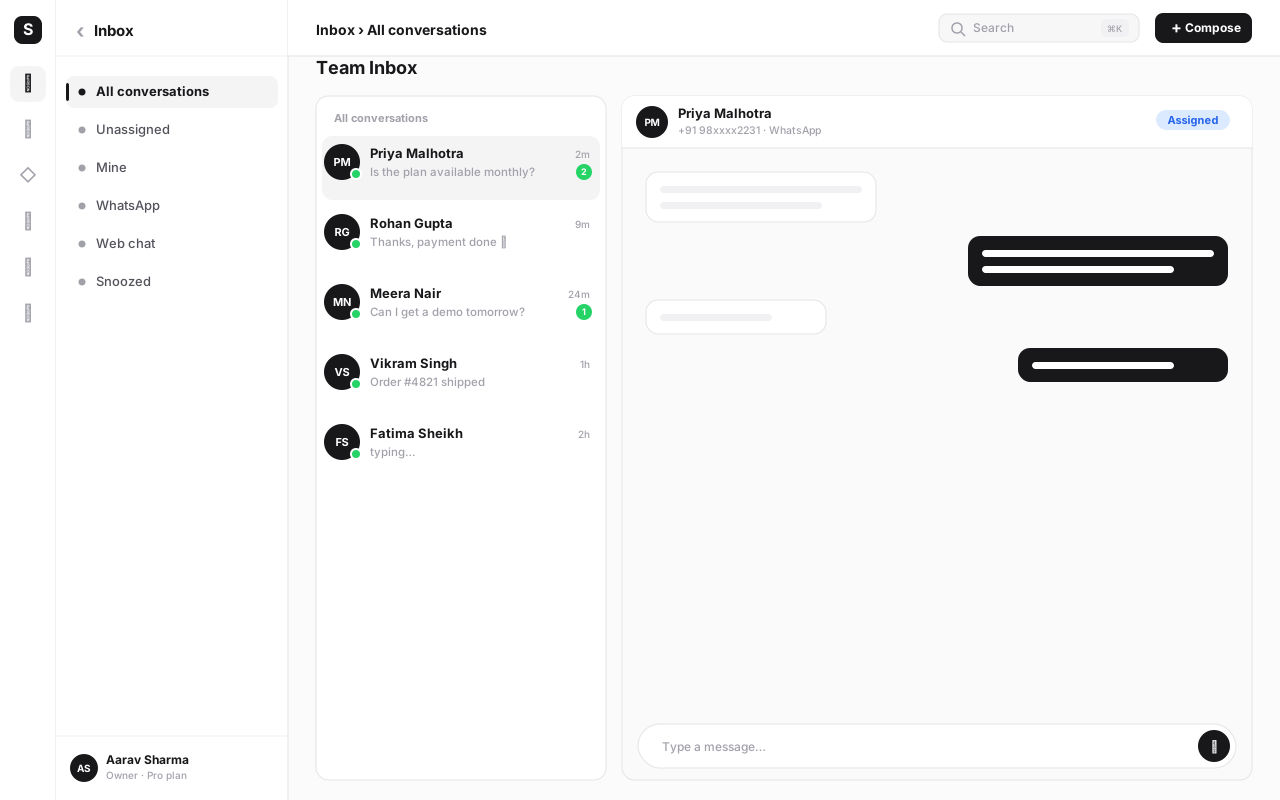
Wati is built around a shared team inbox with routing rules. Conversations land in a common pool and get assigned to available agents based on rules (round-robin, tags, availability), which suits support and service teams where the specific agent matters less than fast, correct resolution. You can still track per-agent performance in Wati, but the underlying model is "the team owns the inbox," not "each agent owns their leads."
If your mental model of your WhatsApp operation is "my reps each work their own patch," DoubleTick's structure will likely feel more natural out of the box. If your mental model is "our team collectively handles whatever comes in," Wati's shared-inbox-with-routing model fits more directly.
Chatbot and flow builder depth#
Wati generally has the deeper automation story here. Its visual, drag-and-drop flow builder supports branching logic, structured data collection, conditional paths based on customer replies, and clean hand-off points to a human agent. Businesses that want WhatsApp to handle a meaningful chunk of first-contact triage — answering FAQs, qualifying a lead before a human steps in, walking a customer through an order-status flow — tend to find Wati's builder does more of that work without custom development.
DoubleTick's automation leans lighter, closer to templated replies and agent-assisted structure than a full conversational flow engine. That's consistent with its sales-outbound focus: the product optimizes for a human agent moving fast through conversations with helpful templates and quick replies, rather than replacing that agent with a bot for the first several turns of a conversation.
Neither approach is wrong for its target use case. A sales team where every lead should hear from a real human quickly may not need (or want) a deep bot layer standing between the lead and the rep. A support or e-commerce operation fielding hundreds of repetitive "where's my order" questions benefits a lot from Wati's flow depth deflecting those before a human is needed.
Integrations and ecosystem#
Wati has generally invested more visibly in a wide integration catalog — native connectors to common e-commerce, helpdesk and CRM tools, plus Zapier and Make support for everything else. That breadth matters if WhatsApp is one piece of a toolchain you've already built around other software and you'd rather connect than replace.
DoubleTick's integration story is comparatively narrower and more tightly scoped to sales workflows — think basic CRM sync or lead-source connections rather than a sprawling app marketplace. For a team that lives inside DoubleTick as its primary daily tool and doesn't need it to talk to a dozen other systems, that narrower scope isn't necessarily a problem; it just means less flexibility if your stack is unusually varied.
Either way, confirm the current integration list on each vendor's site before deciding — these catalogs expand frequently and a gap you noticed a year ago may already be closed.
Pricing: what to actually compare#
Both companies publish tiered pricing, and both bill Meta's own WhatsApp conversation charges separately from their software fee — that part is structural to how the WhatsApp Business API works everywhere, not a choice either vendor makes. Beyond that:
| Aspect | DoubleTick | Wati |
|---|---|---|
| General pricing shape | Historically tiered around agents/numbers for sales teams — confirm current tiers on doubletick.io | Historically tiered around feature sets and message volume — confirm current tiers on wati.io |
| Meta conversation charges | Billed separately by Meta, on top of the software fee | Billed separately by Meta, on top of the software fee |
| Best-fit buyer | Small-to-mid sales teams counting per-agent cost | Teams weighing cost against broader feature/integration usage |
Neither company's exact current pricing should be quoted from memory or from an old blog post — plan names, tiers and included quotas change. Before making a decision, pull up current pricing directly on doubletick.io and wati.io, and ask each vendor's sales team to confirm what's included in writing, since verbal quotes and website copy can drift out of sync.
How to evaluate a WhatsApp API tool for your sales team#
- Map your actual daily workflow first. Write down what a rep or agent literally does all day — is it "message a big list, then follow up individually" (points toward DoubleTick's model) or "handle whatever comes into a shared inbox, sometimes with a bot doing first-pass triage" (points toward Wati's model)? Choosing the tool before mapping the workflow is how teams end up fighting their software.
- Count your real message volume and check it against Meta's tier limits. Meta's own 24-hour conversation limits (250 / 1K / 10K / 100K / unlimited, based on your number's quality rating and history) apply regardless of which platform you choose — no software vendor can send faster than Meta allows for your specific number.
- Test the agent-assignment model with your actual team size. If you have five sales reps, try assigning leads the way DoubleTick's per-agent model works, and separately try Wati's shared-inbox routing, with a real trial account. The "right" model is often obvious once you've tried both with your own leads rather than a demo dataset.
- Build one real chatbot flow (or decide you don't need one) before buying. If a flow builder matters to you, don't take a demo video's word for it — build one actual flow (a simple FAQ triage or order-status lookup) in each platform's trial and see how much friction there is.
- List every tool you'll need WhatsApp to talk to. CRM, helpdesk, e-commerce platform, calling tool, SMS gateway — write the list, then check each candidate's integration catalog against it, not just against a generic "does it integrate with Zapier" checkbox.
- Get current pricing in writing for your actual usage, not a generic tier. Ask each vendor to quote your real agent count, expected message volume and required features, then compare total monthly cost including Meta's conversation charges — not just the sticker price of the cheapest tier.
- Run a real trial with real leads for at least two weeks. A short trial with dummy contacts won't surface the friction (or lack of it) in your actual sales process. Use real (opted-in) leads for a genuine two-to-four-week test before committing to an annual contract.
Common mistakes when choosing between WhatsApp API tools#
Picking based on a feature demo instead of your actual workflow. A flashy chatbot demo or a slick bulk-send screen doesn't tell you whether the tool matches how your specific team actually works day to day — test with your own process, not the vendor's script.
Ignoring Meta's own messaging limits when comparing "broadcast capacity." No platform can exceed Meta's per-number 24-hour conversation ceiling — if a vendor implies otherwise, that's a red flag, not a feature.
Comparing sticker prices without adding Meta's conversation charges. Both DoubleTick and Wati bill Meta's charges separately from their own software fee — the real monthly cost is software fee plus Meta charges, not just the plan price you see first.
Assuming agent-ownership and shared-inbox models are interchangeable. DoubleTick's per-agent structure and Wati's shared-inbox-with-routing structure produce genuinely different day-to-day experiences for a sales team — don't assume you can bolt one team's habits onto the other tool's model without friction.
Not checking current pricing before making the final call. Quoting numbers from an old comparison article (including this one, over time) instead of the vendor's live pricing page is one of the most common ways teams end up surprised by their first invoice.
Overlooking what happens once you outgrow WhatsApp-only. Many sales teams that start with a WhatsApp-only tool eventually also want a CRM, a dialer, and SMS — and only then realize they're evaluating, buying and integrating three more subscriptions on top of whichever WhatsApp tool they picked first.
Where SabNode fits#
DoubleTick and Wati are both, at their core, WhatsApp-first tools — that's their whole job, and both do it credibly for their respective target users. If WhatsApp genuinely is the entire job for your team — nothing else needs to plug in, no CRM, no calling, no SMS — either one is a reasonable, focused choice, and this comparison should help you pick the one whose model (agent-owned outbound vs. shared-inbox-with-automation) fits how your team actually works.
Where it's worth pausing is if you already know — or suspect — that WhatsApp won't stay your only channel for long. Most growing businesses eventually also want a CRM to track the pipeline those WhatsApp leads sit in, a calling tool for the follow-up call after the WhatsApp message, an SMS channel for customers without a smartphone or reliable data, and email for the formal paper trail. At that point, the question stops being "which WhatsApp tool is best" and becomes "do I want to integrate a standalone WhatsApp tool with three or four other subscriptions, or start on a platform where those pieces are already the same product."
That's the gap SabNode's WaChat module is built to fill. It includes WhatsApp Business API, broadcast campaigns, a chatbot/flow builder, a product catalog and a shared team inbox — covering the same core ground as DoubleTick and Wati — natively unified with a full CRM (SabCRM/SabBigin), cloud calling (SabCall), SMS (SabSMS), business email (SabMail), automation (SabFlow) and payments (SabPay), all under one login, one bill, and one customer timeline. Pricing is transparent and published: Starter is free forever (2 users, 1,000 contacts, 500 messages/mo); Growth is ₹2,499/mo or ₹24,990/yr (10 users, 50,000 contacts, all modules); Scale is ₹9,990/mo or ₹99,900/yr (unlimited users, 500,000 contacts).
This isn't a claim that SabNode's WhatsApp features are necessarily deeper than DoubleTick's sales-outbound tooling or Wati's chatbot builder feature-for-feature — it's a different kind of bet: that most businesses would rather have WhatsApp, CRM, calling, SMS and payments all read from the same contact record than manage the best individual tool for each channel separately. If that structural trade-off appeals to you more than picking the single best WhatsApp specialist, it's worth a look.
See WhatsApp bundled with CRM, calling and SMS on one login
WaChat covers the same WhatsApp ground as DoubleTick and Wati — broadcast, chatbot builder, shared inbox, catalog — natively connected to CRM, calling, SMS and payments. Start free on sabnode.com, no credit card required.
Conclusion#
DoubleTick and Wati are both credible, India-built WhatsApp Business API platforms, and neither is a wrong choice in the abstract — they're simply built around different jobs. DoubleTick's strength is a fast, agent-owned, broadcast-heavy workflow tuned for sales teams; Wati's strength is a deeper chatbot/flow builder and a wider integration catalog for teams running a more general WhatsApp operation. The best way to choose is to map your team's actual daily workflow against each product's model rather than picking off a feature checklist or last year's pricing snapshot.
If, after that comparison, you realize your real need is broader than WhatsApp alone — a CRM for the pipeline, a dialer for the follow-up call, SMS for the customers WhatsApp doesn't reach — it's worth reading our WhatsApp Business API complete guide for the fundamentals, and taking a look at how an all-in-one platform like SabNode's WaChat handles that same WhatsApp workload alongside everything else on one bill. Whichever direction you go, confirm current pricing directly with each vendor before you commit — DoubleTick, Wati and SabNode all publish tiers that are worth checking fresh rather than trusting any single comparison article, including this one, as the final word.
Frequently asked questions
Is DoubleTick better than Wati for a sales team?
For a team whose entire job is high-volume outbound WhatsApp — broadcasting offers, assigning leads to individual salespeople, tracking who replied to whom — DoubleTick's per-agent number model and mobile-first app are built specifically for that workflow, and many sales-led SMBs find it faster to onboard for that one job. Wati can also broadcast and assign conversations, but it's built as a more general WhatsApp platform with a heavier chatbot/flow layer, which can feel like more product than a pure outbound sales team needs. If broadcast-and-assign is 90% of your use case, evaluate DoubleTick first; if you also need a serious chatbot builder or a wide integration catalog, give Wati equal weight.
Does Wati have a visual chatbot builder?
Yes — Wati's chatbot/flow builder is one of its core strengths, letting you build branching conversational journeys with a drag-and-drop canvas, collect structured answers, and hand off to a human agent when a conversation needs one. It's generally considered deeper than what DoubleTick offers, since DoubleTick leans more toward templated broadcast and agent-assisted replies than fully automated conversational flows.
Can DoubleTick assign WhatsApp numbers to individual sales agents?
Per-agent number and conversation assignment is one of DoubleTick's defining features — it's built around the idea that each salesperson in a team should have their own WhatsApp identity (or a clearly assigned slice of a shared number) so leads know who they're talking to and managers can see individual rep performance. Wati supports assigning conversations to agents within a shared inbox too, but its model leans more toward a team pool with routing rules rather than DoubleTick's agent-centric structure.
Which is cheaper, DoubleTick or Wati?
Both companies publish tiered plans that change over time, so treat any specific number you've seen as a snapshot rather than current fact — confirm current pricing on their respective sites (doubletick.io and wati.io) before comparing. As a general shape, DoubleTick has historically priced around per-agent or per-number tiers aimed at sales teams, while Wati has tiered around broader feature sets and message volume. Neither publishes numbers we'd repeat here with confidence, and both bill Meta's own per-conversation charges separately on top of their software fee.
Do DoubleTick and Wati integrate with other business tools?
Wati has historically invested more heavily in this — a library of native integrations plus Zapier and Make connectors, aimed at plugging into whatever CRM, helpdesk or e-commerce stack you already run. DoubleTick's integration story tends to be narrower, reflecting its focus on being a standalone sales-outbound tool rather than a hub that connects to everything else. If deep third-party integration matters more to you than sales-specific workflow, that's a point in Wati's favor; confirm the current integration list on each vendor's site since these catalogs expand often.
What's a good alternative to DoubleTick and Wati if I need more than WhatsApp?
If your business already needs (or will soon need) a CRM, calling, SMS or email alongside WhatsApp, it's worth looking at all-in-one platforms like SabNode, whose WaChat module bundles WhatsApp Business API, broadcast, a chatbot builder, catalog and shared inbox natively with CRM, calling, SMS, email and payments on one login. It's a different kind of product than either DoubleTick or Wati — not a straight WhatsApp-for-WhatsApp swap — so it's worth evaluating on whether you want one bill and one contact record instead of a best-of-breed WhatsApp tool plus separate CRM/calling/SMS subscriptions.
Can I switch from DoubleTick or Wati to another platform without losing my WhatsApp number?
Generally yes. Your WhatsApp Business Account (WABA) and phone number belong to you and Meta, not to whichever Business Solution Provider currently manages API access for it. Moving to a new platform — whether that's between DoubleTick and Wati or to a different provider entirely — is a standard Meta re-verification process, not a new-number signup. You'll typically need to export your contacts and re-submit your approved message templates on the new platform, but the number itself and its verification status carry over.