SabNode vs AiSensy: Which WhatsApp API Tool Fits Your Team?
AiSensy is known for affordable WhatsApp API pricing in India. SabNode matches the WhatsApp essentials and adds a full CRM, calling, SMS and automation on one timeline.
AiSensy is a well-regarded, WhatsApp-only API and marketing tool, popular in India for its affordable entry pricing, broadcast tooling and India-first onboarding support. SabNode's WaChat module matches those WhatsApp essentials — broadcasts, a chatbot/flow builder, catalog, shared inbox — then adds a native CRM, cloud calling, SMS, email and cross-channel automation on the same contact timeline. The right choice depends on whether WhatsApp is the only channel you'll ever need, or the first of several.
SabNode vs AiSensy at a glance#
Both platforms give you the core of a WhatsApp Business API tool: an official Meta connection, template management, broadcast sending, a chatbot or flow builder, and a shared inbox for a team to answer conversations together. The difference shows up once you look past WhatsApp — at what else the platform can do with the same contact, and what depth its CRM, automation and reporting actually have.
The table below lines up the two on the dimensions that matter most when picking a WhatsApp API vendor: pricing model, broadcast limits, chatbot depth, CRM, other native channels, integrations and support.
| Dimension | AiSensy | SabNode (WaChat) |
|---|---|---|
| Pricing model | WhatsApp-only tiered plans, historically low-to-mid hundreds of rupees/month for entry tiers — confirm current tiers on aisensy.com | Free Starter, then ₹2,499/mo Growth (all modules) — see pricing |
| Broadcast campaigns | Segmented broadcasts, template scheduling, delivery reporting | Segmented broadcasts, template scheduling, delivery reporting |
| Chatbot / flow builder | Rule-based flows and basic automation on WhatsApp replies | Visual flow builder plus Meta Flows, shared with automation across channels |
| Product catalog / commerce | WhatsApp catalog support | Catalog plus custom e-commerce flows and WhatsApp Ads |
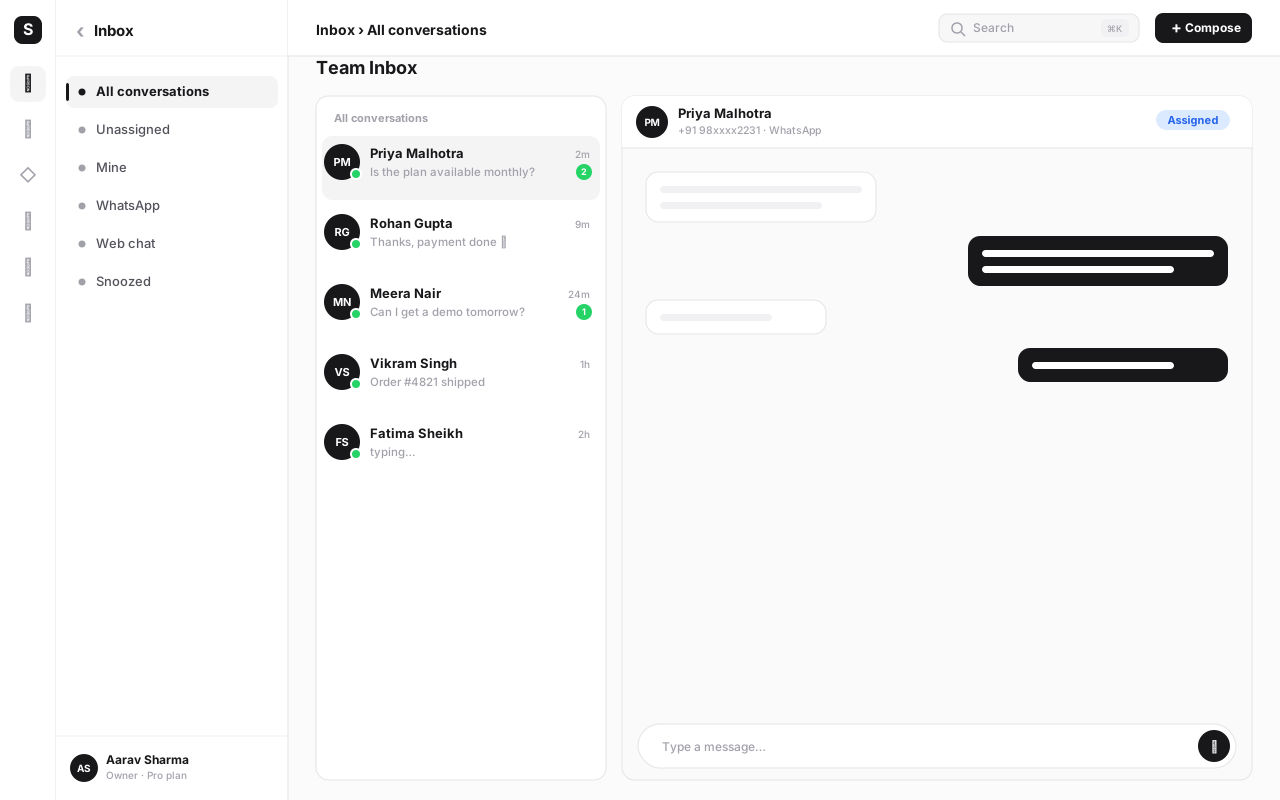
| Shared team inbox | Yes, scoped to WhatsApp | Yes, unified with SabChat live chat and CRM activity |
| Native CRM | Not native — typically paired with a separate CRM | Native (SabCRM full CRM or SabBigin lite pipeline CRM) |
| Native calling / IVR | Not offered | Native (SabCall cloud calling, IVR, queues) |
| Native SMS | Not offered | Native, DLT-compliant (SabSMS) |
| Native email | Not offered | Native (SabMail business email hosting) |
| Cross-channel automation | WhatsApp-scoped automation only | Cross-module automation (SabFlow) across WhatsApp, SMS, email, CRM, calling, payments |
| Payments / e-sign | Not offered natively | Native (SabPay payment links/UPI, SabSign e-signatures) |
| Support model | India-first onboarding and support, well regarded | Community Slack on free tier; priority support from Growth plan up |
| Best fit | WhatsApp-only businesses on a tight budget | Businesses that want WhatsApp now and room to add channels later |
Read the table as a starting point, not a verdict. If your business genuinely never needs anything beyond WhatsApp broadcasts and basic replies, the WhatsApp-only row-for-row comparison is close, and AiSensy's focus is a legitimate reason to pick it. The gap opens up in every row below the WhatsApp line.
It also helps to be specific about who each row actually serves. A solo founder running a single WhatsApp number for order updates and FAQ replies rarely feels the missing rows at all — a chatbot builder and a broadcast tool cover most of what that business does in a day. A small sales team fielding inbound WhatsApp leads, following up by phone, and closing with a payment link feels every one of those missing rows within the first month, because the handoffs between tools are exactly where deals stall. Knowing honestly which business you are before you compare pricing saves you from optimising for the wrong thing.
Where AiSensy is genuinely strong#
It's worth being direct about what AiSensy does well, because it does a real job well rather than being a thin wrapper around the WhatsApp API.
Affordable, WhatsApp-scoped pricing. AiSensy built its reputation on entry tiers that are cheap relative to enterprise WhatsApp API resellers, aimed squarely at Indian SMBs and solo marketers who want a WhatsApp presence without an enterprise contract. Exact tiers and included message volumes shift over time, so confirm current pricing directly on aisensy.com rather than trusting any number, including ours, as current.
A genuinely usable broadcast tool. Segmenting a contact list, scheduling a templated broadcast and watching delivery and read reporting come in is AiSensy's bread and butter, and by most accounts it's a smooth, dependable experience for that specific job.
India-first onboarding. Getting a WhatsApp Business API number live involves Meta's Business Manager, template approval and (for many businesses) a Business Solution Provider in the middle of that process. AiSensy has built real expertise in walking Indian businesses through that setup, which matters more than people expect — a clumsy first week with WhatsApp API onboarding is a common reason small teams give up on the channel entirely.
A basic chatbot layer that covers common cases. Keyword-triggered replies, simple decision trees and away messages cover a large share of what small teams actually need from "automation" on WhatsApp, and AiSensy delivers that without much complexity.
None of that is faint praise. A tool that does one job well, at a fair price, with good support, is a legitimate choice — and for a business that will only ever need WhatsApp, it may remain the simpler pick even after reading the rest of this article.
It's also worth crediting the ecosystem AiSensy has built around that focus: a large base of Indian SMB customers, partner agencies who set up campaigns on a client's behalf, and enough market presence that hiring someone who already knows the tool isn't hard. For a business whose entire digital presence is a WhatsApp number and a product catalog, that familiarity and the lighter price tag are real, defensible reasons to choose it over a broader platform — you shouldn't feel talked out of a tool that fits a genuinely narrow need.
Where the comparison changes: what's next to WhatsApp#
The honest case for SabNode isn't "AiSensy is bad at WhatsApp" — it isn't. The case is about what sits next to WhatsApp once your business needs more than one channel, which happens to almost every business that grows past its first few months on WhatsApp API.
No native CRM means a second tool, sooner than you'd like. The moment you need pipeline stages, deal values, custom fields for your industry, or a report on which lead source actually converts, AiSensy's WhatsApp-only scope means you're evaluating and paying for a separate CRM — then building and maintaining a connector (usually Zapier or a webhook) to keep the two in sync. That connector is itself a maintenance cost and a point of failure; if it breaks silently, your CRM quietly stops reflecting reality.
No calling or SMS means fragmented follow-up. A lead who messages on WhatsApp and later needs a call — because some conversations genuinely convert faster on a call — has to be handed off to a completely separate dialer with no visibility into the WhatsApp thread. The same is true for SMS: a delivery failure notice, an OTP, or a DLT-compliant transactional message needs its own gateway and its own compliance registration, layered on top of the WhatsApp setup you already did.
Automation stops at the WhatsApp boundary. AiSensy's automation is real, but it's scoped to what happens inside a WhatsApp conversation. A rule like "if a broadcast reply doesn't convert in 48 hours, send an SMS and create a CRM task" needs three systems to talk to each other — WhatsApp tool, SMS gateway, CRM — each with its own API, its own webhook format and its own place to break.
The second table below makes the "what do I actually need to run this workflow" comparison concrete, using a few common jobs a growing WhatsApp-first business runs into.
| Job to be done | With AiSensy alone | With SabNode / WaChat |
|---|---|---|
| Send a segmented WhatsApp broadcast | Native — AiSensy's core strength | Native, same capability |
| Track a lead through a sales pipeline | Needs a separate CRM + connector | Native CRM on the same contact record |
| Call a lead who asked a complex question | Needs a separate dialer, no WhatsApp context | Native calling; agent sees the WhatsApp thread first |
| Send a DLT-compliant transactional SMS fallback | Needs a separate SMS gateway + DLT registration | Native, DLT-compliant SMS module |
| Automate "no reply in 48h → SMS + CRM task" | Requires stitching 3 tools with Zapier/webhooks | One automation, native to the platform |
| Send a payment link after a WhatsApp order | Needs a separate payments tool | Native payment links/UPI (SabPay) |
| See a customer's full history in one place | Open multiple tools and reconcile manually | One contact timeline across every channel |
Don't ask "which tool is cheaper per WhatsApp message" — both are competitive there. Ask "what does my business need to do with a WhatsApp contact six months from now," and price the whole workflow, connectors included, not just the WhatsApp line item.
The total cost most comparisons miss#
Price-per-message comparisons flatter WhatsApp-only tools because that's the one number every vendor prices to be competitive on. The number that rarely makes it into a comparison is what it costs, in money and in engineering time, to make a WhatsApp-only tool behave like part of a real customer record.
Consider the realistic shape of that cost for a small sales-and-support team. First there's the second subscription — a CRM, priced and paid separately, often per seat, so the same five people you already pay for in your WhatsApp tool get paid for again. Then there's the connector: either a paid Zapier or Make plan to move data between the two, or a developer's time to write and maintain a webhook integration, both of which need to be revisited every time either vendor changes their API. Then there's the failure mode nobody budgets for — a connector that silently stops syncing for a week, during which your CRM quietly drifts out of date and nobody notices until a manager asks why a hot lead from ten days ago was never followed up. None of that shows up on either vendor's pricing page, and all of it is real.
None of this means AiSensy is overpriced for what it does — it isn't. It means the fair comparison is total cost of running the workflow you actually need, not the sticker price of the WhatsApp piece alone. Run that fuller comparison honestly and a bundled platform's ₹2,499/mo often lands close to, or below, "AiSensy plus a CRM plus a connector plus the time to maintain it" — while removing the silent-failure risk entirely, because the modules read and write the same database instead of syncing across an API boundary.
Who should actually pick which#
Being specific about the two clearest cases helps more than a generic "it depends."
Pick AiSensy if: WhatsApp is your only outbound and inbound channel today and you're confident it will stay that way; your team is one or two people who don't need pipeline stages or deal reporting; your budget is the single deciding factor and you can live without a CRM, calling or SMS for the foreseeable future; and you already have a CRM you're happy with and just need a WhatsApp layer bolted on, connector and all.
Pick SabNode if: you expect to add a second channel — SMS, calling or email — within the next year, which is true of most growing SMBs; you want leads, conversations and deals on one contact record without building and maintaining a connector; you'd rather test a full platform for free than commit to a WhatsApp-only tool and re-evaluate everything again in twelve months; or you already run more than one of these functions across separate tools today and are tired of reconciling them by hand.
SabNode and AiSensy, side by side on trade-offs#
Neither platform is objectively "better" in the abstract — they're built for different scopes. Here's the honest trade-off for each.
How to evaluate and switch WhatsApp API providers#
Whether you're choosing your first WhatsApp API tool or considering a move from AiSensy, evaluate methodically rather than on price alone.
- List every channel you use today, not just WhatsApp. Write down whether you also run SMS, calling, email or a CRM as separate tools, and note which of those already talk to each other and which don't. If the answer is "yes, several, and they don't sync," price the whole stack you'd need alongside a WhatsApp-only tool, not just its own subscription.
- Price the connector, not just the subscription. If a CRM or automation link is required to make a WhatsApp-only tool useful for your workflow, add its monthly cost, its setup time and the ongoing time someone spends keeping it working to the comparison. A cheaper core tool with an expensive, fragile connector can end up costing more than a single bundled subscription.
- Test the chatbot/flow builder with a real scenario. Build the exact flow you actually need — a catalog browse-to-order flow, or a support triage flow that routes to the right agent — in each tool's builder before deciding. Marketing pages all look similar; builders don't, and the gap only shows up when you try to build something specific.
- Check template approval and number-migration mechanics. Ask how long template approval realistically takes with each vendor's support team and how a WhatsApp Business number is migrated in or out, so you know the process isn't a surprise later. A number stuck mid-migration for a week is a real business cost, not a technicality.
- Confirm current pricing directly on each vendor's site. WhatsApp API pricing (both platform fees and Meta's conversation-based charges) changes periodically for every vendor. Don't rely on any article, including this one, for the number you'll actually be billed — check aisensy.com and sabnode.com/pricing at the time you decide, including what happens to your bill if you go over your message or contact limit.
- Start on the free or lowest tier before committing. SabNode's Starter plan is free forever for 2 users, 1,000 contacts and 500 messages/month — enough to test WaChat's broadcast, chatbot and inbox against your real templates and your real customers before paying anything at all.
- Migrate one channel at a time if you do switch. Move WhatsApp first, run it alongside your existing tool for a few days, confirm delivery and reporting match expectations, then decommission the old tool rather than cutting over everything at once.
The line item that looks identical — "cost per WhatsApp message" — is rarely where the real cost difference lives. It lives in what you have to buy, integrate and maintain next to WhatsApp once your business needs a second channel. Price the whole workflow before you decide.
Try WaChat free before you decide
Run your real broadcast templates and chatbot flows on SabNode's free Starter plan, then compare the result to your current WhatsApp API tool — no credit card required.
Common mistakes when picking a WhatsApp API tool#
Teams evaluating AiSensy, SabNode or any other WhatsApp API provider tend to trip on the same handful of errors.
- Comparing headline WhatsApp pricing only. Two tools can look identical on "price per message" while one requires a second CRM subscription and a connector to be usable for your actual workflow. Price the whole stack — subscriptions, connectors and the time to maintain them — not just the WhatsApp line.
- Assuming a WhatsApp-only tool will stay WhatsApp-only forever. Most businesses that start with just WhatsApp add SMS, calling or a CRM within the first year as the team and the customer base grow. Choosing a tool with zero path beyond WhatsApp doesn't save money long-term; it just delays the second evaluation and the second migration to a moment when you have less time to do it carefully.
- Skipping a real flow-builder test. Reading a features list isn't the same as building your actual catalog-to-order or support-triage flow inside the tool. Build it before you commit; some builders that look powerful on a features page are clumsy the moment you try to model a specific, real flow with branches and fallbacks.
- Underestimating template approval and number-migration time. Assuming a WhatsApp number and its templates will be ready instantly leads to launch delays that ripple into a marketing calendar you've already committed to. Start the migration or approval process before you need it live, and build a few days of buffer into your launch date regardless of which vendor you pick.
- Forgetting DLT and consent rules apply beyond WhatsApp. If SMS is even a maybe for later, remember DLT sender-ID and content-template registration take real business days in India — plan for it rather than discovering it under deadline pressure when a campaign is due to go out.
- Not testing support responsiveness before committing. Message a vendor's support channel with a real setup question during evaluation, on both platforms, and time how fast and how useful the answer is. That's a better predictor of your day-to-day experience than any sales call or demo.
- Treating "all-in-one" as automatically worse or automatically better. Neither is true by default. A broad platform is only a win if its individual modules are genuinely good — test the CRM, the calling and the chatbot builder each on their own merits, not just on the pitch that they're conveniently bundled together.
Conclusion#
AiSensy earned its reputation the honest way — a focused, affordable WhatsApp API tool with real broadcast depth and India-first onboarding support, and for a business that will only ever need WhatsApp, that focus is a legitimate reason to choose it. SabNode's WaChat module matches those same WhatsApp essentials — broadcast, catalog, chatbot builder, shared inbox — and then keeps going: a native CRM, cloud calling, DLT-compliant SMS, business email and cross-channel automation, all on one contact timeline, at ₹2,499/mo for the Growth plan once you outgrow the free Starter tier.
The right call comes down to one honest question: is WhatsApp the only channel this business will ever run, or the first of several? If it's the former, AiSensy's narrower, cheaper scope is a fair pick — just confirm its current tiers on aisensy.com. If it's the latter, which is true for most growing businesses, paying once for a platform that already includes the CRM, calling and SMS you'll need next avoids a second evaluation, a second migration and a connector to keep it all in sync. For a deeper look at what the WhatsApp Business API itself covers before you compare vendors, see our WhatsApp Business API complete guide, and for chatbot design specifics, the WhatsApp chatbot automation guide.
Whichever way you lean, test before you commit. Run your real templates and flows on SabNode's free Starter plan and weigh the result against your current tool with your own numbers, not anyone else's marketing page.
Frequently asked questions
Is SabNode a good AiSensy alternative?
Yes, if you want the same WhatsApp Business API essentials — broadcast campaigns, a chatbot/flow builder, product catalog and a shared inbox — plus a native CRM, cloud calling, SMS and email on the same contact timeline. If your only requirement is the cheapest possible way to send WhatsApp broadcasts and you never plan to add another channel, AiSensy's WhatsApp-only pricing may still be worth a look; confirm its current tiers on aisensy.com before deciding.
How does SabNode's pricing compare to AiSensy's?
AiSensy is known for tiered plans that historically start in the low-to-mid hundreds of rupees per month for entry tiers, scoped to WhatsApp only — confirm current numbers on aisensy.com since they change. SabNode's Growth plan is ₹2,499/mo (or ₹24,990/yr) and includes WhatsApp plus SMS, email, calling, CRM and automation for up to 10 users, 50,000 contacts and 50,000 messages/month across any channel. There's also a free Starter plan (2 users, 1,000 contacts, 500 messages/month) to trial the whole platform before you commit.
Does AiSensy have a built-in CRM?
AiSensy's core strength is the WhatsApp layer — broadcasts, templates, a shared inbox and basic chatbot flows — rather than a full CRM with pipelines, deal stages and custom objects. Many AiSensy customers pair it with a separate CRM and stitch the two together with Zapier or a custom webhook. SabNode includes a full CRM (SabCRM) natively, so every WhatsApp conversation already sits on the same contact record as calls, SMS, email and payments.
Can I use SabNode for WhatsApp only, the way I use AiSensy today?
Yes. You can run WaChat on its own and ignore the other modules — nothing forces you to turn on calling, SMS or CRM. The difference is that those modules are one login away, already synced to the same contacts, if you ever need them. You're not paying a WhatsApp-only price for a WhatsApp-only feature set that later requires a second vendor to expand.
Which is better for WhatsApp broadcast campaigns, SabNode or AiSensy?
Both platforms handle segmented broadcast sends, template approval workflows and delivery reporting well — this is AiSensy's core competency and it's genuinely good at it. Where SabNode pulls ahead is what happens after the broadcast: a reply can trigger a cross-channel automation (an SMS fallback, a CRM task, an agent assignment) without a separate integration, because broadcast, inbox and CRM share one engine.
How hard is it to switch from AiSensy to SabNode?
The WhatsApp Business API number itself moves through Meta's standard number-migration process, typically completed within a business day once you start it. Message templates need to be recreated in WaChat (Meta doesn't transfer template libraries between BSPs), and it's worth exporting your contact and conversation history from AiSensy first so nothing is lost. Most teams run both tools in parallel for a few days before cutting over fully.
Is AiSensy or SabNode more India-focused?
Both are built by and for the Indian market. AiSensy is well known for India-first onboarding support and WhatsApp-specific pricing tuned to Indian SMB budgets. SabNode is built the same way but extends the India-first approach across channels — DLT-registered SMS, UPI/rupee billing and DPDP Act-aware data handling — so the same compliance posture covers WhatsApp and SMS rather than just one channel.