SabNode vs Zoho One: Which All-in-One Platform Wins in 2026?
Zoho One bundles 45+ business apps. SabNode bundles the channels and CRM you actually use every day, with WhatsApp and India compliance built in. Here's how they really compare.
Zoho One is a bundle of 45+ separately built business apps licensed per employee across your whole company, while SabNode is a smaller, natively unified suite — WhatsApp, calling, CRM, SMS, email, automation, payments and e-signatures — priced per workspace with India-first compliance (WhatsApp Business API, DLT SMS, UPI) built in rather than bolted on. Zoho One wins on sheer breadth and maturity if you genuinely use many of its 45 apps; SabNode wins when your business runs on a handful of customer-facing channels and needs them to share one contact timeline instead of living in different apps. The right pick depends on how many of those 45 apps you'd actually open every week versus how much a single unified record matters to your team.
This comparison covers the real differences: what each platform actually includes, how pricing works (per-employee vs per-workspace), India-specific compliance, the migration path if you're switching, and — honestly — which company should pick which. We won't pretend Zoho One is thin; it's one of the most mature software bundles on the market, built over roughly two decades and used by hundreds of thousands of businesses worldwide. But breadth and fit are different things, and this article is about fit — specifically, fit for a growing Indian business whose customers live on WhatsApp, phone calls and SMS, and whose team needs one record of every customer rather than forty-five separate ones.
Zoho One and SabNode at a glance#
Before comparing features line by line, it helps to see what kind of product each company actually is — because they're built on fundamentally different premises.
Zoho One is Zoho Corporation's "operating system for business": one subscription that unlocks essentially every product Zoho makes — CRM, Books (accounting), Desk (helpdesk), People (HR), Mail, Projects, Analytics, Recruit, Campaigns, Sign, Creator (low-code) and dozens more. It has been built and expanded over roughly two decades, which is exactly why it's so wide. The trade-off of that history is that many of the 45+ apps were built by different teams at different times, so the interface, data model and even naming conventions shift as you move between them.
SabNode is a tighter suite purpose-built for growing Indian businesses that live on a smaller set of high-frequency channels: WhatsApp (WaChat), team inbox/live chat (SabChat), cloud calling and IVR (SabCall), DLT-compliant SMS (SabSMS), business email (SabMail), CRM (SabCRM, plus a lighter pipeline CRM called SabBigin), no-code automation across hundreds of app integrations (SabFlow), payments and UPI (SabPay), e-signatures (SabSign), project management (SabPM) and spreadsheets (SabSheet). Every module is built natively on one shared data model, so a contact record, a conversation and a deal look and update the same way no matter which module you're in.
The philosophical difference traces back to how each product came to exist. Zoho grew its 45-app catalog over roughly twenty years, largely by building (and occasionally acquiring) products one category at a time and then unifying them under single sign-on and a shared admin console. That approach produces enormous breadth, but it also means each app inherited its own release cadence, its own interface conventions and, in places, its own vocabulary for the same underlying concept — a "contact" in one app isn't always structured quite like a "contact" in another. SabNode took the opposite path: start with one data model — one definition of a contact, a conversation, a deal — and build every module as a native citizen of that model from the first line of code. Neither approach is wrong; they simply optimize for different things. Zoho optimized for coverage across every conceivable back-office and front-office function. SabNode optimized for the customer-facing core being genuinely one system, not forty-five.
| Snapshot | Zoho One | SabNode |
|---|---|---|
| What it is | Bundle of 45+ separately built Zoho apps | Unified suite of channels + CRM on one data model |
| Core apps in scope | CRM, Books, Desk, People, Mail, Projects, Analytics, Recruit, Campaigns, Sign, Creator, and more | WaChat, SabChat, SabCall, SabSMS, SabMail, SabCRM/SabBigin, SabFlow, SabPay, SabSign, SabPM, SabSheet |
| Licensing unit | Per employee, company-wide ("All Employee Pricing") | Per workspace (users, contacts and messages scale within a plan) |
| Data model | Many apps, unified mainly by SSO and an admin console | One native data model shared across every module |
| India-first channels | Not the core design point — integrations vary by app | Native WhatsApp Business API, DLT SMS, UPI payments |
| Maturity | Very mature; some apps date back well over a decade | Newer, focused suite for growing Indian businesses |
| Best fit | Companies deep in the Zoho ecosystem needing many niche apps | Companies whose business runs on WhatsApp/SMS/calling + CRM |
Feature-by-feature comparison#
This is the part that actually matters for a buying decision: not "how many apps" but "does this platform natively do the things my business does every day."
| Capability | Zoho One | SabNode |
|---|---|---|
| Native WhatsApp Business API | Available via CRM/Desk integrations; not a first-party dedicated module | Native module (WaChat) — templates, shared inbox, automation |
| DLT-compliant bulk/transactional SMS | Typically via third-party SMS gateway integrations | Native module (SabSMS) built around India's DLT framework |
| Cloud calling / IVR | Zoho Voice exists but is a narrower, separate product | Native module (SabCall) — cloud calling, IVR, queues, recordings |
| UPI / India-native payments | Payment gateway integrations, not a first-party UPI product | Native module (SabPay) with UPI, payment links |
| CRM depth | Zoho CRM — mature, highly configurable, large ecosystem | SabCRM (full) + SabBigin (lite pipeline CRM) — natively linked to every channel |
| Cross-module automation | Possible via Zoho Flow/Deluge scripting between apps | Native cross-module automation (SabFlow) — no separate glue product needed |
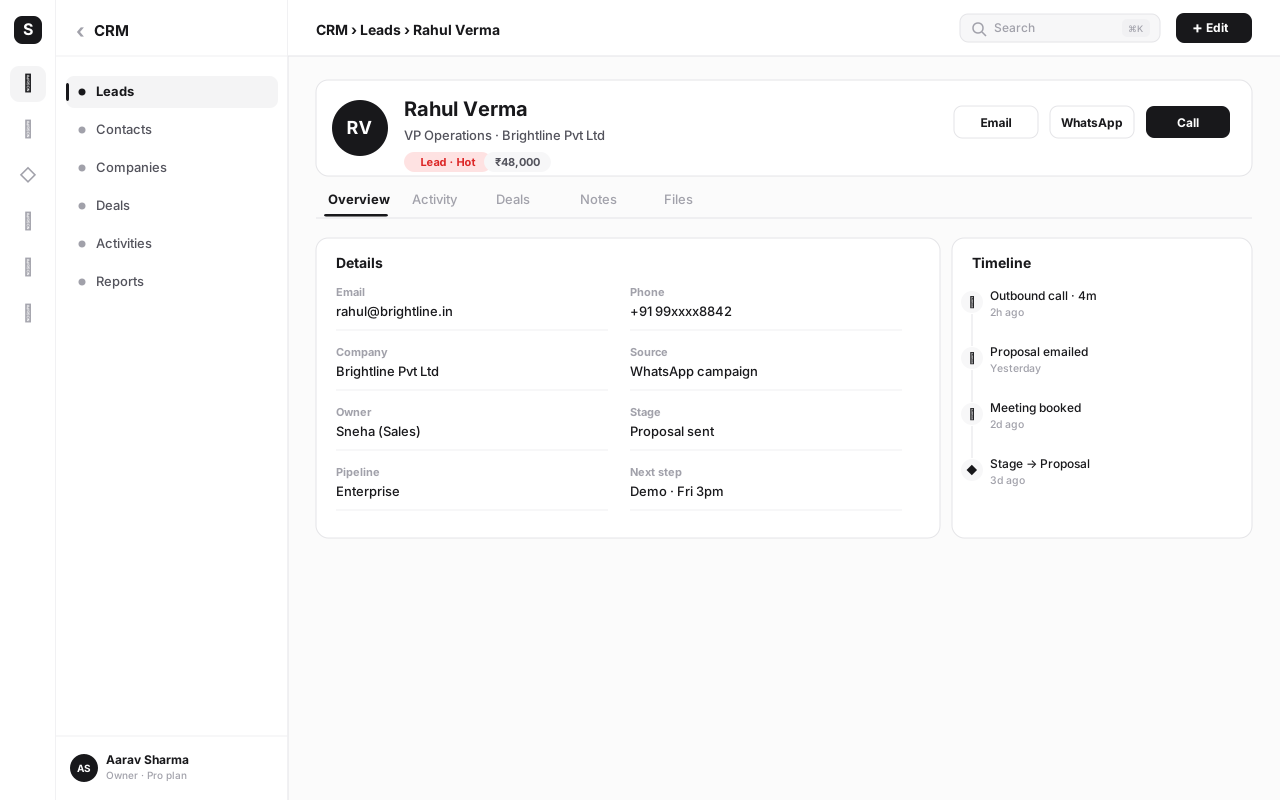
| Unified contact/customer timeline | Varies by app; CRM is the closest hub but not every app feeds it equally | One timeline by default across WhatsApp, calls, SMS, email, deals, payments |
| Accounting, HR, recruiting depth | Deep, dedicated apps (Books, People, Recruit) at real scale | Not SabNode's focus — integrate via SabFlow if needed |
| Licensing model | Per employee, company-wide | Per workspace (10 users on Growth, unlimited on Scale) |
| India support hours / compliance focus | Global support model; India compliance not the primary design axis | Built for India-first businesses (DLT, WhatsApp Business API, DPDP-readiness) |
| E-signature | Zoho Sign — solid, dedicated product | Native module (SabSign) tied to the same contact record |
| Analytics / BI | Zoho Analytics — powerful, general-purpose BI | Native, built on the same unified data |
Zoho Books, Zoho People, Zoho Recruit and Zoho Analytics are each genuinely deep, dedicated products with years of feature development behind them — not thin add-ons. If your business runs serious accounting, HR or recruiting workflows at scale, Zoho's specialist apps in those categories can be hard to beat, and SabNode does not try to replicate them. This comparison is scoped to the customer-facing channels + CRM + automation core where the two platforms genuinely overlap.
A day in the life: same customer, two platforms#
Feature tables are useful, but the structural difference between "45 apps unified by SSO" and "one native data model" only becomes obvious when you follow a single customer through a working day on each platform.
Picture a customer who messages your business on WhatsApp on Monday morning asking about a product. On a Zoho One stack, that message typically lands wherever your WhatsApp integration is configured — often surfaced inside Zoho CRM or Zoho Desk as a linked conversation. On Tuesday the same customer calls your sales line; whoever answers needs to know to check the CRM's activity tab for Monday's WhatsApp thread, and depending on how the integration was set up, that context may or may not be one click away. On Wednesday, marketing sends a promotional SMS through a separate SMS gateway connected via an integration or Zoho Flow — that gateway may not automatically know a live WhatsApp conversation is already underway, so the customer gets pitched something they already asked about. By Thursday, when they're ready to pay, the invoice comes from Zoho Books and the contract from Zoho Sign — both correct, both dependable, but each living in its own app with its own view of "this customer."
On SabNode, the same Monday-to-Thursday journey writes to one contact record from the first message. The WhatsApp thread, Tuesday's call and its recording, Wednesday's SMS (which the platform can suppress automatically because a live conversation is open on another channel), Thursday's payment link and the signed contract all attach to the same timeline. The agent who answers Tuesday's call sees Monday's WhatsApp message without switching screens. Nobody re-explains the product. Nothing gets pitched twice.
This isn't a claim that Zoho CRM lacks activity tracking — it has plenty. The difference is architectural: Zoho's WhatsApp, SMS and messaging capabilities generally arrive at the CRM through an integration layer, so how completely they show up on one screen depends on how that integration was configured and maintained. SabNode's channels write to the same record because they were built as the same system from day one. For a team of two or three people, the gap may not matter much. For a growing sales and support team fielding hundreds of these journeys a week, it's the difference between an agent who looks prepared and one who looks like they've never spoken to this customer before.
Pricing: per-employee vs per-workspace#
This is where the two platforms diverge most structurally, and it's worth understanding why the numbers behave so differently, not just what they are.
Zoho One's headline model is "All Employee Pricing" — every employee in the company needs a license, whether or not they ever open a Zoho app. Historically this has been quoted in the rough range of $37-45 per employee per month billed annually (Zoho also offers a smaller flexible/per-user tier for a subset of employees, with different terms). Pricing and packaging change periodically, so confirm the current numbers directly at zoho.com/one/pricing before budgeting — don't rely on any figure, including this one, without checking the live page.
The practical effect of per-employee licensing is that the bill scales with your org chart, not your usage. A 100-person company with 20 people actually using Zoho apps still often has to license closer to the full headcount under All Employee Pricing, because that's the model's core mechanic. For companies that spread Zoho apps widely across departments — sales in CRM, HR in People, finance in Books, support in Desk — that's a fair trade for 45 apps. For companies where only a sales and support team touch the software, it's expensive breadth they don't need.
SabNode prices per workspace, and the plan already includes every module:
| Plan | Price | Includes |
|---|---|---|
| Starter | Free forever | 2 users, 1,000 contacts, 500 WhatsApp/SMS messages/mo, core features of every module |
| Growth (most popular) | ₹2,499/mo or ₹24,990/yr (~20% off yearly) | 10 users, 50,000 contacts, 50,000 messages/mo any channel, ALL modules, priority support, audit log, Google SSO, BYO-key AI |
| Scale | ₹9,990/mo or ₹99,900/yr | Unlimited users, 500,000 contacts, 500k messages/mo with burst, SSO/SAML/SCIM, region pinning, dedicated success manager |
| Enterprise | Custom | Unlimited everything, single-tenant + VPC, SOC 2/ISO 27001, BYO-KMS, custom SLAs, on-prem option |
Overage on Growth and Scale is never a hard block — extra messages bill at ₹0.10 each and extra contacts at ₹0.05 each beyond plan limits, so a busy month doesn't cut off your WhatsApp or SMS sending.
Do the arithmetic for your own headcount before deciding. A 10-person team on SabNode Growth pays a flat ₹2,499/mo (about ₹250/employee/month) for every module. The same 10 people on Zoho One's per-employee model, at roughly $37-45/employee/month (again — verify current pricing), lands meaningfully higher for a company that mostly needs WhatsApp, CRM, calling and SMS rather than the full 45-app spread. Flip the scenario to a 150-person company running Books, People, Recruit, Projects and CRM in genuine daily use across departments, and Zoho One's per-app cost can look very reasonable — you're getting a lot of real software for that per-employee number.
Who should pick which#
Neither platform is "better" in the abstract — they're built for different shapes of business, and the honest answer genuinely depends on what your organization does most.
Pick Zoho One if: you're already invested in the Zoho ecosystem and switching costs would be high — years of workflows, custom Deluge scripts and trained staff don't move cheaply; you need niche, deep apps like Zoho Books for accounting or Zoho People for HR at real organizational scale, where a specialist product genuinely outperforms a general one; your team spreads usage widely across many departments (finance, HR, recruiting, support, sales, projects) so per-employee licensing amortizes well because most employees really do use several of the 45 apps; and WhatsApp, SMS and India-specific compliance aren't the center of how you run the business, so a native module for them isn't a priority.
Pick SabNode if: WhatsApp, SMS and calling are core to how you sell and support customers — not a side channel but the main way people reach you — and you want native WhatsApp Business API and DLT-registered SMS rather than a third-party integration bolted onto a CRM; a single unified customer timeline, one contact record visible across every channel, matters more to your team than having access to 45 apps most of which would sit unused; you'd rather pay per workspace than per employee as your team grows, so hiring doesn't automatically inflate your software bill; and you want one consistent design language and data model instead of learning the conventions of 45 individually built products, each with its own quirks.
There's also a hybrid answer worth naming honestly: some growing companies keep a specialist Zoho app (Books for accounting is the most common) while running their customer-facing channels, CRM and automation on SabNode, connecting the two with an integration. That's not a failure of either platform — it's exactly the "best-of-breed for your genuine edge, unified for everything else" pattern that tends to work best in practice.
See if SabNode fits your stack better than a 45-app bundle
Try SabNode free — WhatsApp, CRM, calling, SMS, email, automation, payments and e-sign on one workspace, no credit card required, no per-employee licensing.
Migrating from Zoho One to SabNode#
If you've decided the fit favors SabNode, migrate deliberately rather than switching everything on the same day — you want to prove each piece before you retire the Zoho license behind it. A phased migration also means your team never has a moment where a customer-facing channel is down while you figure out the new tool.
- Audit what you actually use in Zoho One today. List which of the 45 apps your team genuinely opens weekly versus which sit unused, and by which department. This tells you exactly what needs a like-for-like replacement, what you can simply stop paying for once you cancel, and what specialist app (like Books) you might keep regardless.
- Export your CRM data. Pull contacts, deals, notes and activity history out of Zoho CRM as a CSV or API export, and import them into SabCRM (or SabBigin if you want the lighter pipeline CRM) so your customer history travels with you instead of starting fresh. A unified timeline is only as valuable as the history it contains.
- Stand up your highest-friction channel first. If WhatsApp integration in Zoho has always felt bolted-on, connect WaChat first. If calling has been the pain point, start with SabCall. Solve your biggest daily irritation first so the win is felt immediately and the team buys into the switch.
- Start WhatsApp Business API and DLT SMS approvals early. WhatsApp Business API verification and DLT entity/sender ID registration for SMS both take a few business days to process through the respective authorities. Kick these off in parallel with your CRM migration so they're ready when you need them, not a blocker later in the timeline.
- Run Zoho and SabNode side by side for one channel. Before fully cutting over, operate both systems for a week or two on the first migrated channel, comparing outcomes and watching for anything that fell through the cracks, so you catch gaps while Zoho is still your safety net.
- Migrate remaining channels one at a time. Move SMS, email, payments and e-sign in sequence, each with a brief parallel-run period, rather than a single big-bang cutover across all of Zoho One in one weekend.
- Wire up cross-module automation. Once your data lives in one place, build the automations that Zoho Flow or Deluge scripting made harder to maintain across separate apps — a payment that triggers a WhatsApp confirmation, a new lead that starts a call sequence — natively in SabFlow, with no connector to babysit.
- Keep specialist Zoho apps you're not replacing. If you rely on Zoho Books or Zoho People at real depth, there's no need to replace them — connect them to SabNode via SabFlow's integrations rather than trying to force everything onto one vendor just for the sake of consolidation.
- Cancel matched Zoho licenses as each channel goes live. As each function is proven on SabNode, downgrade or cancel the corresponding Zoho seats. The savings from per-workspace pricing only materialize once the old per-employee licenses actually stop — don't let both bills run for months "just in case."
Common mistakes when switching between the two#
- Comparing app counts instead of daily usage. "Zoho One has 45 apps" sounds compelling, but the number that matters is how many you and your team would actually open in a typical week. Score both platforms on your real workflows, not the size of the catalog — a platform with five apps you use daily beats one with forty-five you mostly don't.
- Ignoring per-employee math until the invoice arrives. Teams budget Zoho One based on a handful of power users, then discover the license actually needs to cover the whole company under All Employee Pricing. Confirm the licensing unit and current rate directly with Zoho before committing, and run the math against your actual headcount, not just your core users.
- Assuming WhatsApp/SMS integrations are equivalent to native modules. A CRM-embedded WhatsApp widget and a purpose-built module with template management, a shared team inbox and DLT-aware SMS sending are not the same depth of product. Test the actual messaging workflow end to end — sending a template, handling a reply, seeing it on the contact record — not just whether a checkbox exists in the settings page.
- Big-bang migration in either direction. Switching every app off on the same day — in or out of Zoho One — is the fastest way to lose data and trust in the new system. Migrate channel by channel with a parallel-run period, and only move to the next once the current one is proven.
- Leaving customer history behind. Moving forward with new conversations but abandoning years of CRM notes, deals and message logs breaks the exact "unified timeline" value proposition you're switching for. Import your history first, so day one on the new platform doesn't look like a customer relationship that just started.
- Forgetting India compliance has lead time. WhatsApp Business API approval and DLT SMS registration aren't instant — both typically take a few business days to clear verification. Plan them in parallel with your migration, not as an afterthought once you're ready to send your first message and discover you can't yet.
- Not setting a sunset date for replaced licenses. Paying for both platforms indefinitely "just in case" erases the cost advantage of switching. Set a firm cancellation date for each Zoho app once its replacement is proven, and hold your team to it.
- Underestimating change management. Even a genuinely better platform fails if the team that lives in the old one every day isn't trained and brought along. Treat the switch as a workflow change for people, not just a technical migration, and give staff time to get comfortable before removing their old tools.
Whichever direction you're moving, run a real pilot before committing your whole team. Migrate your CRM data, connect one channel, and use it for a genuine two-week stretch before you cancel anything on the other side. The right platform for your business reveals itself in daily use, not in a feature-list comparison — including this one.
Conclusion#
Zoho One and SabNode solve the "too many tools" problem from opposite directions. Zoho One's answer is breadth: buy one subscription and unlock 45+ mature, individually excellent apps, licensed across your whole company under a single per-employee rate. SabNode's answer is depth on the core: unify the channels and CRM that a growing Indian business touches every single day — WhatsApp, calling, SMS, email, CRM, automation, payments, e-sign — on one native data model, priced per workspace instead of per employee, so your bill tracks usage rather than headcount.
Neither is a universal winner, and any comparison that tells you otherwise is selling something. If you're already deep in the Zoho ecosystem and genuinely run Books, People, Recruit and half a dozen other specialist apps at scale across a large organization, Zoho One's per-app value is real and hard to beat — you'd be hard-pressed to replace that breadth with any single alternative. If your business lives on WhatsApp, SMS and calling, needs India compliance (DLT registration, WhatsApp Business API, UPI) to be native rather than stitched together through an integration, and would rather see every customer on one timeline than manage the interface quirks of 45 separate logins, SabNode is built specifically for that shape of company.
The honest test is your own weekly usage, not either vendor's feature list — including this one. Map what your team actually opens today, price both models against your real headcount rather than a handful of power users, and pilot the channel that hurts most before switching anything else. Whichever way the audit points, do the migration in phases, keep your customer history intact, and give your team room to adopt the new system before you retire the old one. For the full breakdown of what's included at each tier, see the pricing page, browse the complete list of products, or read what SabNode actually is if you're comparing it for the first time against your current stack.
Frequently asked questions
Is SabNode cheaper than Zoho One?
It depends on headcount and which apps you actually use. Zoho One licenses per employee across the whole company (historically quoted around $37-45/employee/month billed annually — confirm current pricing at zoho.com/one/pricing since Zoho updates it), so the bill scales with your org chart even if half your staff never touch half the apps. SabNode prices per workspace, not per employee: the Growth plan is ₹2,499/mo (or ₹24,990/yr) for 10 users with every module included, and Scale is ₹9,990/mo (or ₹99,900/yr) for unlimited users. A 20-person team that only needs WhatsApp, CRM, calling, SMS and email will usually land cheaper on SabNode; a 200-person company that genuinely runs Zoho Books, Zoho People, Zoho Recruit and 15 other apps at scale may find Zoho One's per-app breadth cheaper per app, even if the per-employee math is steeper.
Does Zoho One include WhatsApp Business API?
Zoho has WhatsApp integrations across its CRM and desk products, but native, first-party WhatsApp Business API with built-in template management, shared team inbox and compliance handling is not the core design point of the 45-app bundle the way it is for SabNode. If WhatsApp is your primary customer channel — which it is for most India-first businesses — check exactly what Zoho's current WhatsApp integration covers before assuming it matches a purpose-built module.
Does Zoho support DLT-compliant SMS in India?
Zoho's SMS capabilities are typically delivered through third-party integrations rather than a native, DLT-registered sending engine built into the core platform. SabNode's SMS module (SabSMS) is built around India's DLT (Distributed Ledger Technology) framework from the ground up — entity and sender ID registration, template scrubbing and compliant delivery are native, not bolted on through a connector.
Can I migrate from Zoho One to SabNode without losing data?
Yes, if you migrate in phases rather than switching everything at once. Export contacts, deals and historical records from Zoho CRM and import them into SabCRM, connect one channel at a time (start with whichever channel — WhatsApp, calling or email — causes the most daily pain in Zoho today), and run both systems in parallel for that channel until you trust the new one. Only then move the next app and cancel the matching Zoho license.
Is Zoho One good for a company that uses very few of the 45 apps?
Not ideal. Zoho One's value proposition is strongest when you use many of the 45 apps deeply — that's when the per-app cost genuinely looks cheap. If you only need three or four core functions (say, CRM, email, a helpdesk and calling), you're paying an all-employee license for 40+ apps you'll never open, which is expensive breadth you don't need. A focused suite like SabNode, priced for the modules a growing business actually runs day to day, is usually the better fit in that case.
Which platform has a more unified user experience, SabNode or Zoho One?
Zoho One is 45+ individually built products, acquired and developed over many years, unified mainly by single sign-on and a shared admin console — so navigation, design language and even terminology can vary from app to app. SabNode's modules are built natively on one shared data model and one design system from the start, so a contact, a conversation and a deal look and behave the same way whether you're in WhatsApp, calling, CRM or SMS. If a single, consistent day-to-day experience across every tool matters more to your team than the sheer number of available apps, that consistency favors SabNode.
Should I pick Zoho One or SabNode for a growing Indian business?
Pick Zoho One if you're already deep in the Zoho ecosystem, need niche apps at real scale (like Zoho Books for accounting or Zoho People for HR across a large workforce), and per-employee licensing works fine for your headcount. Pick SabNode if WhatsApp, SMS, calling and a single customer timeline are core to how you sell and support, if India compliance (DLT, WhatsApp Business API, UPI) needs to be native rather than integrated, and if you'd rather pay per workspace than per employee as your team grows.