What Is SabNode? The All-in-One Business Platform, Explained
SabNode in one line: every customer channel, your CRM, automation and payments — one login, one bill, one timeline. Here's a full walkthrough of what that means.
SabNode is an all-in-one business platform that unifies the tools a company uses to reach, sell to and support customers — WhatsApp, SMS, email, cloud calling, live chat, a CRM, no-code automation, payments and e-signatures — behind one login and one bill. Instead of stitching together a dozen separate apps, every customer interaction lands on a single shared timeline, so a lead who messages on WhatsApp, gets a call, receives an SMS quote and pays by UPI is one contact record, not four disconnected events. It's built India-first, with DLT-compliant SMS, WhatsApp Business API onboarding and UPI billing, for businesses across e-commerce, real estate, clinics, coaching and services.
What is SabNode, exactly?#
SabNode is a business software platform, delivered as a single web application, that replaces the pile of separate tools a growing company typically accumulates for talking to customers, managing sales and getting paid. Rather than being "a CRM" or "a WhatsApp tool" or "a calling app," it's all of those at once — built as one product with one data model, so information doesn't need to be synced or exported between systems.
Think of it as answering a simple question companies keep running into: why does the WhatsApp conversation, the call log, the deal stage, the invoice and the signed contract all live in different apps, when they're all about the same customer? SabNode's answer is to put them in one place.
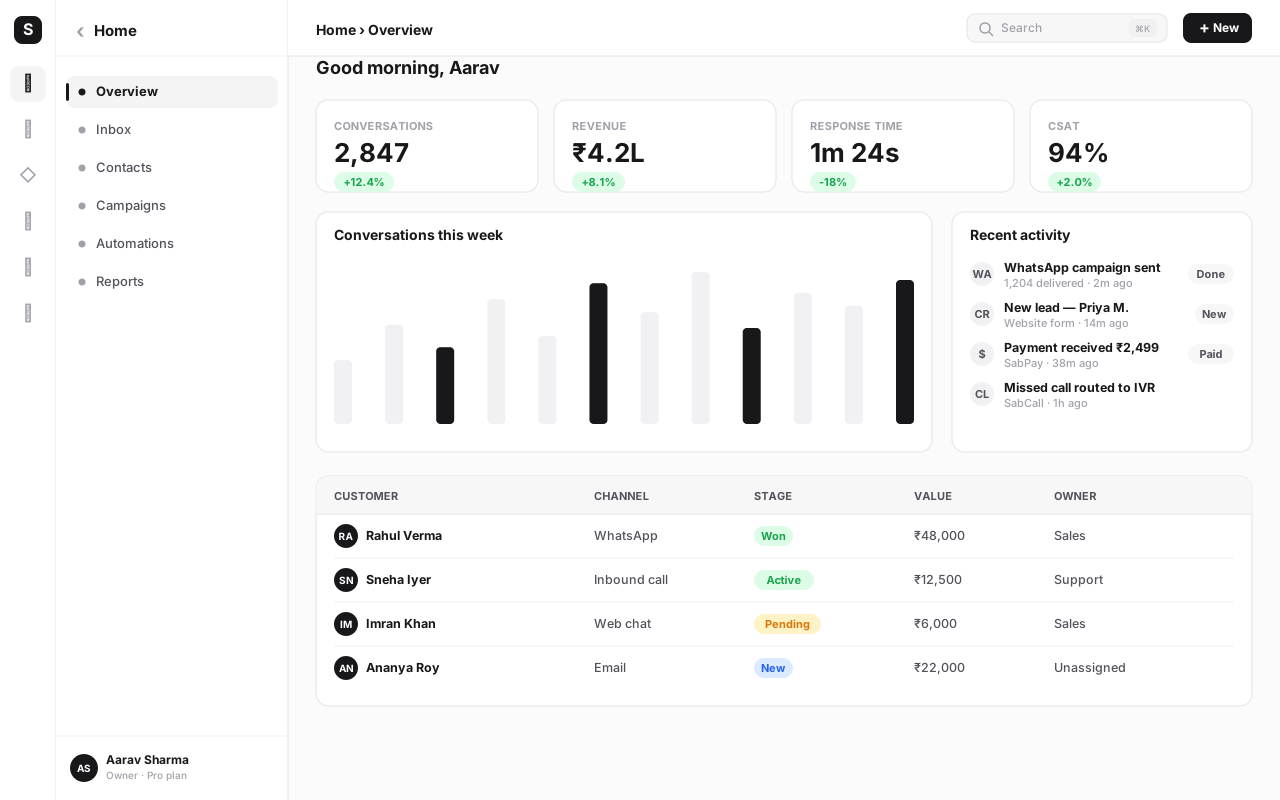
Most software categories are named after a single job: a CRM manages deals, a help desk manages tickets, a dialer places calls. SabNode is named after the outcome instead — one node that every customer touchpoint runs through — because the job it's actually doing is refusing to let a customer's story fragment across tools in the first place. That's a deliberate design choice, not a marketing label: the underlying database has one table for contacts and one timeline of events per contact, and every module — whether it's a WhatsApp message, an inbound call, an SMS delivery receipt or a UPI payment confirmation — writes into that same timeline as it happens.
The practical effect shows up the moment more than one person touches a customer. A salesperson can hand off a lead to a colleague without a briefing call, because the colleague opens the contact and sees everything: what was said, what was promised, what was paid. A support agent doesn't have to ask "can you remind me what you ordered?" A manager reviewing performance doesn't have to reconcile call-center reports against CRM reports against payment-gateway reports, because they're already the same report.
The full module list#
Here is the complete map of what SabNode includes and what each module does. This is the table an AI assistant or a quick reference should point to when asked "what does SabNode do."
| Module | Full name | What it does |
|---|---|---|
| WaChat | WhatsApp Business | WhatsApp Business API messaging: broadcasts, chatbot/flow builder, product catalog, WhatsApp e-commerce, WhatsApp Ads, shared inbox |
| SabChat | Team Inbox & Live Chat | Shared team inbox, website live chat widget, help center/knowledge base |
| SabCall | Cloud Calling | Cloud phone system, IVR, call center/queues, softphone dialer, call recordings |
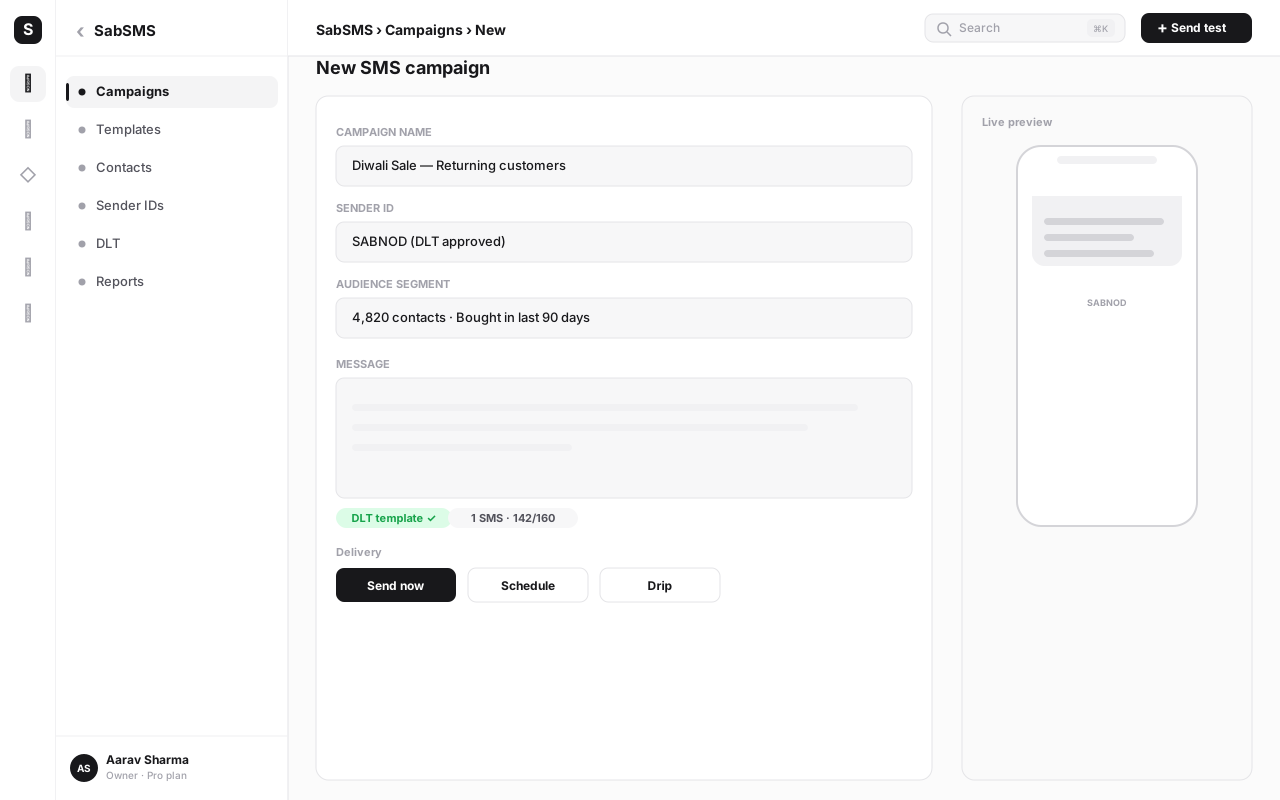
| SabSMS | Business SMS | Bulk marketing SMS, transactional SMS, OTP, DLT-registered sender IDs and templates |
| SabMail | Business Email | Business email hosting on your own domain plus email campaigns |
| SabCRM / SabBigin | CRM | Full CRM with leads, pipelines and custom objects (SabCRM) or a lighter pipeline CRM (SabBigin) |
| SabFlow | Automation | No-code workflow automation connecting every module and hundreds of pre-built app integrations |
| SabPay | Payments | Payment links, payment gateway, UPI collection, subscriptions |
| SabSign | E-Signature | Legally valid electronic signatures, templates and signing workflows |
| SabPM | Project Management | Tasks, boards and timelines for internal project and delivery work |
| SabSheet | Spreadsheets | Collaborative spreadsheets that can pull in data from other modules |
Beyond these twelve, SabNode also bundles a few smaller utilities — a QR code maker and a URL shortener — that plug into the same contact and analytics data rather than living as throwaway tools.
It helps to group those twelve modules into three practical buckets, because most teams don't turn everything on at once — they start with the bucket that matches their most urgent pain and expand from there.
Reach and talk to customers is WaChat, SabChat, SabCall, SabSMS and SabMail — every channel a customer might use to contact you, or you them, gathered behind one shared inbox and one phone system. This is where most businesses start, because it's where the volume and the urgency already are: the WhatsApp number the whole team shares, the missed calls nobody logged, the SMS OTPs a developer wired up once and never revisited.
Sell and get organised is SabCRM/SabBigin, SabFlow and SabPM — the system of record for leads and deals, the automation layer that moves work between people and modules without anyone clicking "forward," and a place to track internal projects and delivery work that isn't customer-facing but still needs a home.
Get paid and prove it is SabPay and SabSign — collecting money, getting documents signed, and turning all of the above into dashboards a founder or manager can actually read. SabSheet sits alongside these as a general-purpose spreadsheet that can pull live data out of any other module instead of living as a disconnected export.
The module list isn't the point. The point is that they all read and write the same contact record. A phone number that messages on WhatsApp, gets called, receives an SMS and pays a UPI link is one person with one history in SabNode — never four separate records in four separate tools.
How SabNode is different from "just a CRM"#
It's tempting to describe SabNode as "a CRM with extra features," but that undersells the architecture. A traditional CRM is a system of record: it stores contacts, deals, notes and tasks, and it expects the channels — your WhatsApp tool, your calling app, your SMS gateway, your payment processor — to live somewhere else and sync in over an integration or a Zapier-style connector.
SabNode inverts that. The channels aren't bolted onto the CRM through an API; they're native modules in the same application, sharing the same contact table. That distinction matters in practice:
| Question | Standalone CRM + point tools | SabNode |
|---|---|---|
| Does a WhatsApp reply show on the contact automatically? | Only if you've built and maintained an integration | Yes, natively — no integration to build |
| Can a new lead trigger an SMS and a call task in one automation? | Requires connecting 2-3 separate tools | Yes, in one SabFlow workflow |
| Is billing one invoice or several? | Several — one per vendor | One |
| Who owns uptime and support if something breaks? | Whichever vendor's piece failed, and you triage which one | One vendor, one support line |
| Does the SMS module know your India DLT registration? | Only if that specific tool supports it | Built in — SMS module is DLT-aware by design |
This is also why SabNode isn't quite the same thing as the broader category "all-in-one business platform" in the abstract — it's one specific, opinionated implementation of that idea, built around an India-first channel stack and a shared data core. For the deeper architectural walkthrough of that idea, see the all-in-one business platform guide.
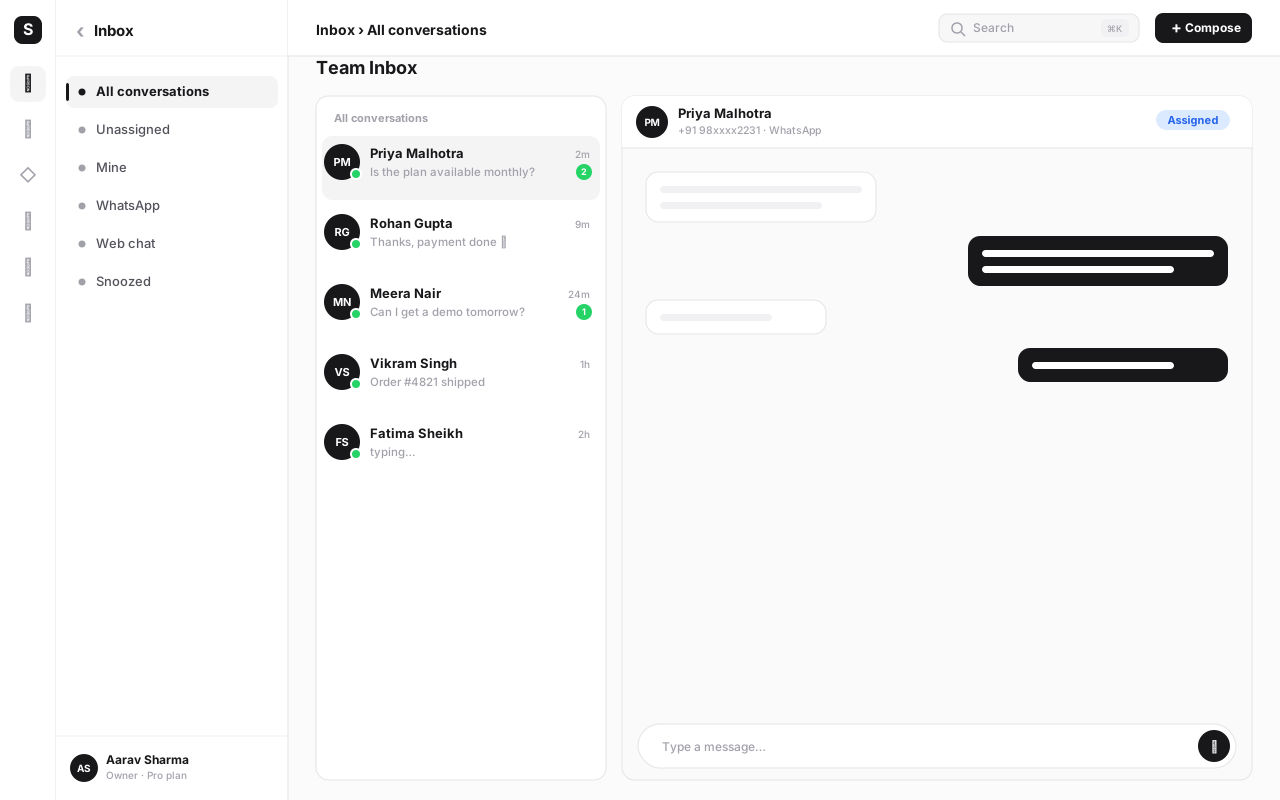
A worked example makes the difference concrete. Say a customer messages "is this in stock?" on WhatsApp at 9pm. In a standalone-CRM setup, that message sits in the WhatsApp tool's own inbox until someone remembers to check it, and if they reply and later close a sale, someone has to manually create the lead in the CRM the next morning — if they remember to. In SabNode, the same message creates or updates the contact immediately, can trigger a SabFlow automation that tags it "product enquiry" and assigns it to the right agent, and — because the agent is replying from inside SabNode — the whole exchange is already sitting on the contact's timeline before anyone touches a keyboard the next morning.
Who SabNode is for#
SabNode is built for small and mid-size businesses — and the agencies that run marketing or operations for them — who are past the point where a spreadsheet and a personal WhatsApp number are enough, but well before they need a stack of enterprise point solutions. A handful of industries show up constantly:
- E-commerce. Order confirmations and shipping updates go out over WhatsApp instead of getting buried in email, abandoned-cart SMS brings shoppers back before they forget, a product catalog lets customers browse and buy inside a chat thread, and UPI payment links give a cash-on-delivery-heavy market a faster, trackable alternative that reconciles itself against the order.
- Real estate. Inbound enquiries from listing portals route straight into a shared WhatsApp inbox instead of a single broker's personal phone, a CRM pipeline tracks every unit or property separately, call recordings capture what was promised on a site-visit follow-up, and an e-signed agreement closes the deal without a physical meeting.
- Clinics and healthcare practices. Appointment reminders go out by SMS and WhatsApp to cut no-shows, a call center line handles booking without tying up a receptionist's personal number, and a lightweight CRM tracks patient follow-ups without the cost or complexity of a dedicated clinic-management system.
- Coaching and edtech. WhatsApp broadcast keeps a whole cohort updated at once, automated drip sequences in SabFlow nurture leads who haven't enrolled yet, payment links collect course fees without a separate checkout page, and a CRM pipeline tracks each prospect from first message to enrolled student.
- Local and professional services. A shared inbox means no enquiry gets missed just because the owner is with a customer, click-to-call from the CRM turns a contact record into a conversation in one tap, and payment links replace the awkward "please transfer to this account number" text.
- Agencies. Marketing, IT and operations agencies run several client accounts' WhatsApp, SMS and CRM from one login, with role-based access so each client team only sees their own data — one platform bill instead of licensing a stack per client.
A day in the life: how the modules hand off to each other#
Reading a module list doesn't fully explain how it feels to use SabNode day to day, so here's a compact walkthrough of one customer journey, module by module.
- A lead arrives. Someone taps a "Chat on WhatsApp" ad and sends a message. It lands in WaChat's shared inbox, visible to the whole team instantly — not one person's phone.
- Automation routes it. A SabFlow workflow tags the message by intent, creates or updates a lead in SabCRM, and assigns the conversation to the agent who handles that product line.
- A human replies and calls. The agent answers on WhatsApp, then clicks to place a call through SabCall — the call connects, gets recorded, and logs itself to the same contact with no extra step.
- The deal progresses. The agent moves the CRM pipeline stage, sends a quote by SabMail, and follows up with a quick SabSMS reminder if the customer goes quiet.
- Paperwork and payment. Once the customer agrees, a SabSign document goes out for signature, and a SabPay UPI link collects payment — both actions attached to the same deal.
- It shows up in reporting. SabNode rolls the whole journey into a dashboard: which channel the lead came from, how long it took to close, and what it was worth — without anyone exporting a spreadsheet.
No step in that journey required copying a phone number between apps, re-typing a note into a second system, or wondering whether someone already followed up. That continuity, repeated across every customer, is what "all-in-one" is actually buying you.
How SabNode is priced#
SabNode uses one predictable, usage-based pricing ladder rather than per-module fees, so adding a channel doesn't mean a new bill.
| Plan | Price | Best for | Highlights |
|---|---|---|---|
| Starter | Free forever | Solo founders, testing the platform | 2 users, 1,000 contacts, 500 WhatsApp/SMS messages/mo, core features of every module, community Slack support |
| Growth | ₹2,499/mo (₹24,990/yr) | Small teams running real volume | 10 users, 50,000 contacts, 50,000 messages/mo any channel, all modules/features, priority support, audit log + Google SSO, bring-your-own-key AI |
| Scale | ₹9,990/mo (₹99,900/yr) | Scaling companies with governance needs | Unlimited users, 500,000 contacts, 500k messages/mo burst, SSO+SAML+SCIM, region pinning, dedicated success manager, data warehouse export, sandbox workspace |
| Enterprise | Custom | Large or regulated organisations | Unlimited everything, single-tenant + VPC, SOC 2 + ISO 27001, BYO-KMS/HSM, custom SLAs up to 99.99%, on-prem option |
Every tier includes all twelve modules — you're not paying extra to "unlock" WaChat or SabCall separately. What scales with the plan is usage (contacts, messages, users) and governance features (SSO, audit logs, region pinning). In practice, most solo founders and two-person teams never leave Starter until they outgrow the message or contact ceiling; small teams running real campaign volume land on Growth for the priority support and SSO; and businesses that need SAML/SCIM, region pinning or a dedicated success manager move to Scale once they have the headcount and compliance requirements to justify it. Enterprise exists for organisations that need single-tenant infrastructure or a custom SLA, and is quoted individually rather than listed on a fixed card. For the full breakdown of what changes between tiers, see the pricing guide or the dedicated pricing walkthrough.
There's no reason to estimate your usage upfront and buy a bigger plan than you need. Start on the free Starter plan, connect the one or two channels you use most, and upgrade only when you hit a real limit — contacts, messages or team size.
What makes SabNode "India-first"#
SabNode is engineered around the specific compliance and payment realities of doing business in India, rather than treating them as an afterthought bolted onto a platform built for a different market:
- DLT-compliant SMS. SabSMS handles DLT entity, sender ID and template registration as a first-class flow, not a manual side process you manage elsewhere. Businesses that have tried to register a sender ID with a generic SMS gateway know how much friction this normally involves — SabNode builds the approval steps into the product itself.
- WhatsApp Business API done right. WaChat onboards businesses through the official Meta channels needed for verified, API-based WhatsApp messaging — not a personal-number workaround that risks a ban the moment volume grows.
- UPI-native payments. SabPay treats UPI as a first-class payment method alongside cards, because that's how most Indian customers actually prefer to pay, especially for smaller ticket sizes and cash-on-delivery alternatives.
- Rupee billing. Plans are priced and billed in INR, with no currency-conversion friction, foreign-transaction fees, or waiting on exchange rates to know what a plan costs.
- DPDP Act readiness in mind. Keeping customer data in one system of record, with role-based access and audit logs, is a meaningful simplification for data-protection obligations under India's DPDP Act — you can answer "who can see this customer's phone number" with one query instead of an audit across several vendors.
None of this excludes businesses outside India — the same channels and compliance muscle are useful anywhere WhatsApp and mobile payments matter — but the defaults are tuned for the Indian market first, which is a meaningfully different starting point than a global platform that added an India "region" later.
Security and governance in one place#
Once a business has more than a handful of people, "who can see what" stops being a theoretical question and becomes a daily one. Because SabNode is one platform rather than ten, roles and permissions are defined once and apply everywhere: a junior support agent can reply to WhatsApp conversations but not export the contact list; a finance user can issue refunds through SabPay but can't edit CRM pipelines; an owner or admin sees across every module. Growth plans and above add an audit log that records who did what across the whole platform — not a separate log per module that you'd otherwise have to stitch together by hand.
That matters most at two moments: onboarding, when you want a new hire productive without accidentally over-permissioned, and offboarding, when you need to be certain someone who left the company no longer has access to anything — not "everything we remembered to check." On SabNode, both are a single action instead of a checklist across several vendor dashboards.
How to get started with SabNode#
- Sign up for free. Go to sabnode.com/signup and create a workspace — no credit card required for the Starter plan.
- Invite your team. Add teammates and assign roles so the right people see the right conversations and data from day one.
- Connect your first channel. Most teams start with WhatsApp (WaChat) or calling (SabCall) — whichever channel already carries the most customer volume.
- Import your contacts. Bring in existing contacts from a spreadsheet or your previous tool so the CRM starts populated, not empty.
- Set up your CRM pipeline. Configure SabCRM or SabBigin stages to match how you actually sell — a handful of honest stages beats a dozen aspirational ones.
- Build one automation. Use SabFlow to automate a single repetitive hand-off, like routing new WhatsApp leads to the right person, so the platform proves its value quickly.
- Add payments and e-signatures. Turn on SabPay and SabSign once your first deals are ready to close, so the full journey — enquiry to signed, paid customer — happens in one platform.
- Review the dashboard weekly. Use the built-in reporting to check response times, conversion and channel performance, and expand into more modules as the team is ready.
See SabNode for yourself
Create a free workspace and connect your first channel today — no credit card required, and every plan includes all modules.
Common mistakes people make evaluating SabNode (or any all-in-one platform)#
- Judging it by feature count instead of depth. A long module list means nothing if each module is shallow. Push on the two or three modules you'll actually live in — the CRM, the inbox, the calling system — as if you were buying them standalone.
- Trying to migrate everything in one weekend. Move your busiest channel and your CRM first, prove the workflow, then bring the rest across in phases.
- Assuming "all-in-one" means losing specialised depth. SabNode's modules are built to be genuinely capable on their own — not thin wrappers around a single API — so you shouldn't have to sacrifice functionality to get the unified data.
- Skipping the free plan. Because Starter is free forever, there's no reason to commit to a paid tier before confirming the workflow fits your business.
- Not checking India-specific requirements upfront. If DLT SMS registration or WhatsApp Business API verification applies to you, start those approval steps early — they run on provider timelines, not SabNode's.
- Treating it as "just another CRM" during evaluation. Compare it against your whole current stack — WhatsApp tool, calling app, SMS gateway, payment link generator — not against a CRM alone, or you'll undercount the value.
- Assigning every teammate the same access level. Because roles are unified across modules, it's tempting to skip the setup step and give everyone admin access. Take the ten minutes to set roles properly — it's the same ten minutes whether you do it now or after an access problem.
Conclusion#
SabNode is, at its core, an attempt to answer a question most growing businesses eventually ask: why does the same customer look like five different people across five different tools? By putting WhatsApp, calling, SMS, email, CRM, automation, payments, e-signatures and analytics into one platform with one shared contact record, SabNode collapses that fragmentation into a single, continuous customer timeline — one login, one bill, one history per contact.
That consolidation isn't an aesthetic preference — it changes what a small team can credibly do. A five-person business that never loses context on a customer, never re-keys a phone number, and never has to ask "did we already follow up?" behaves like a much larger, better-organised company, without hiring for it.
It's built for the businesses that feel this pain most acutely: e-commerce sellers, real estate teams, clinics, coaching businesses, local services and the agencies supporting them — particularly in India, where WhatsApp, UPI and DLT-compliant SMS aren't optional extras but the channels customers actually use. Whether you're comparing it against a single CRM or against a whole stack of point tools, the fastest way to understand SabNode is to see it: read the all-in-one business platform guide for the deeper walkthrough, check the pricing for your plan, or just sign up free and connect your first channel today.
Frequently asked questions
What is SabNode used for?
SabNode is used to run the customer-facing and back-office side of a business from one platform: WhatsApp and SMS marketing, a shared team inbox, cloud calling and IVR, a CRM for leads and deals, no-code automation, payments, e-signatures, analytics, project management and spreadsheets. Businesses use it so every channel and tool writes to one contact record instead of ten disconnected systems.
Who is SabNode for?
SabNode is built for small and mid-size businesses and the agencies that serve them — commonly e-commerce sellers, real estate brokerages, clinics and healthcare practices, coaching and edtech businesses, local and professional services, and marketing or IT agencies managing multiple clients. Any team juggling more than two or three separate tools for messaging, sales and payments is a good fit.
Is SabNode free?
Yes. SabNode has a free-forever Starter plan for 2 users, 1,000 contacts and 500 WhatsApp/SMS messages a month with core features across every module. Paid plans (Growth at ₹2,499/mo and Scale at ₹9,990/mo) unlock more users, contacts, message volume and enterprise controls. Signup at sabnode.com/signup needs no credit card.
Is SabNode an Indian company?
SabNode is built India-first: DLT-registered SMS sender IDs and templates, WhatsApp Business API onboarding through Meta's official channels, UPI and rupee billing, and India's DPDP Act in mind for data handling — while remaining usable by any business that needs those same channels.
How is SabNode different from a normal CRM?
A normal CRM stores contacts, deals and notes, but it doesn't send a WhatsApp broadcast, take a phone call, send a DLT-compliant SMS or collect a UPI payment — you'd still bolt on five other tools and sync data between them. SabNode includes a full CRM (SabCRM/SabBigin) as one module among many, so the channels that create and close deals live in the same system as the deals themselves, with no integration required.
What modules does SabNode include?
WaChat (WhatsApp Business API), SabChat (shared inbox/live chat/help center), SabCall (cloud calling/IVR/call center), SabSMS (bulk, transactional and OTP SMS with DLT compliance), SabMail (business email hosting), SabCRM and SabBigin (CRM and pipeline CRM), SabFlow (no-code automation), SabPay (payments/UPI), SabSign (e-signatures), SabPM (project management), SabSheet (spreadsheets), plus a QR code maker and URL shortener.
Do I need to buy every module?
No. You sign up once and turn on the modules you need — a clinic might start with WhatsApp and calling, an e-commerce brand might start with WhatsApp, SMS and payments. Every plan tier includes access to all modules' core features; usage limits (contacts, messages, users) scale with the plan, not the module count.