What Is an All-in-One Business Platform? The Complete SabNode Guide
WhatsApp, calls, CRM, SMS, email, automation and payments — in one login, one bill, one customer timeline. Here's exactly how an all-in-one platform works and when it beats a stack of point tools.
An all-in-one business platform is a single application that unifies the tools a company uses to reach, sell to and support customers — messaging channels (WhatsApp, SMS, email, calling), a CRM, workflow automation and payments — behind one login, one bill and one shared customer timeline. Instead of paying for and wiring together a dozen point tools, your whole team works in one place, and every interaction with a customer is captured automatically.
This guide explains what that actually means in practice: what an all-in-one platform replaces, how the pieces fit together, where it saves money and time, where it doesn't, and how to evaluate one for your business. We'll use SabNode as the worked example throughout, because it's a platform built exactly this way.
What an all-in-one business platform actually includes#
The phrase "all-in-one" gets used loosely, so it helps to be precise. A genuine all-in-one business platform covers four layers, and the magic is that they share the same underlying data.
- Customer channels — the ways you talk to customers: WhatsApp, SMS, email, voice calls, live chat, social DMs.
- System of record — a CRM that stores every contact, lead, deal and company, plus the full history of interactions.
- Automation — a way to connect events to actions ("new WhatsApp message → create a lead → notify sales") without code.
- Money — getting paid: payment links, a checkout, invoices, subscriptions.
On top of those sit reporting, roles and permissions, settings and increasingly AI capabilities woven through every layer.
Here's how SabNode maps those layers to specific modules:
| Layer | SabNode module | What it does |
|---|---|---|
| WaChat | WhatsApp Business API, broadcasts, chatbot, catalog | |
| Team inbox & chat | SabChat | Shared inbox, live chat widget, help center |
| Calling | SabCall | Cloud phone system, IVR, call center, recordings |
| SMS | SabSMS | Bulk + transactional SMS, OTP, DLT compliance |
| SabMail | Business email hosting + campaigns on your domain | |
| CRM | SabCRM / SabBigin | Leads, pipelines, custom objects, sales automation |
| Automation | SabFlow | No-code workflows across every module and 400+ apps |
| Payments | SabPay | Payment links, gateway, UPI, subscriptions |
| E-signature | SabSign | Legally valid electronic signatures and templates |
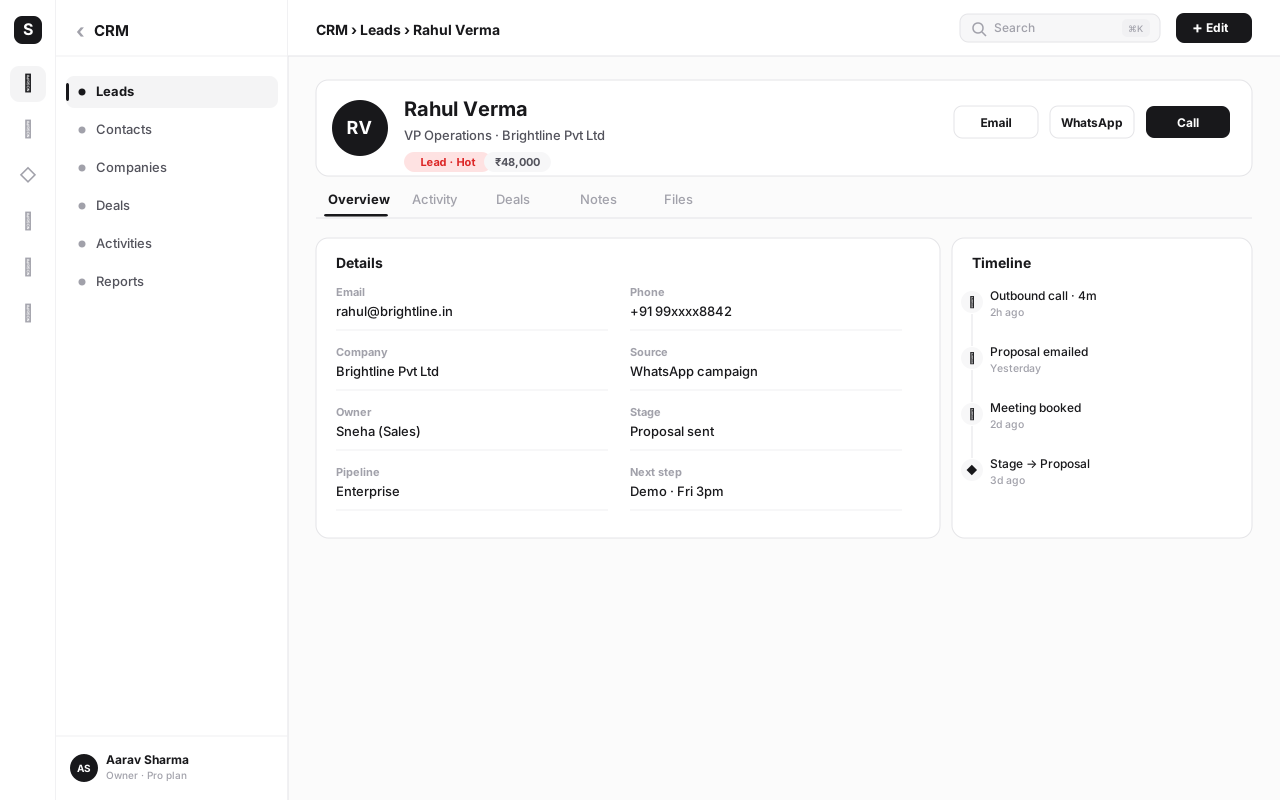
The point isn't the length of that list. It's that a lead who messages you on WhatsApp, gets a call back, receives a quote by SMS and pays with a UPI link is one record with one history — not four disconnected events in four tools.
The core idea: one customer timeline#
If you remember one thing, remember this: the value of an all-in-one platform is not the bundle discount. It's the single timeline.
In a typical stitched-together stack, a customer's story is scattered. The WhatsApp chat is in one tool. The sales notes are in a CRM. The support ticket is in a help desk. The invoice is in accounting software. The call happened on someone's personal phone and was never logged at all. To understand one customer, an employee has to open five tabs and reconstruct the story — and they usually don't, so the customer repeats themselves.
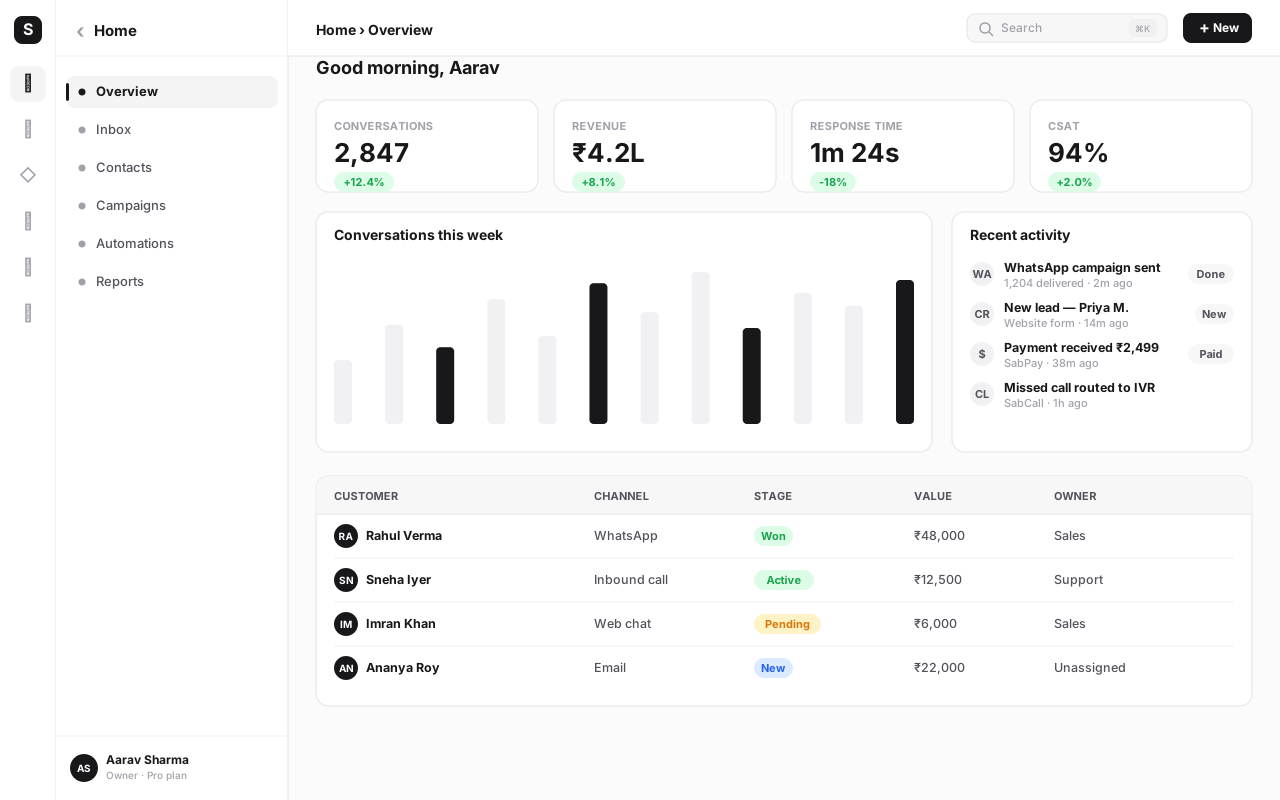
On an all-in-one platform, every one of those interactions writes to the same contact record automatically. Open Rahul Verma's profile and you see, in order: the WhatsApp enquiry, the call your agent made, the proposal you emailed, the payment he made, and the support chat afterwards. Anyone on your team can pick up the conversation with full context.
Customers don't experience your tools — they experience the continuity between them. A unified timeline is what makes a five-person business feel as organised as a fifty-person one. It's the single biggest reason teams consolidate.
What an all-in-one platform replaces#
Most growing businesses don't decide to buy ten tools. They accumulate them — a WhatsApp tool here, a calling app there, a spreadsheet that became the "CRM", an email marketing service, a payment link generator, an e-sign tool for contracts. Each was a reasonable decision in isolation. Together they create cost, friction and blind spots.
Here's a representative "before" stack and what a platform like SabNode collapses it into:
| The job to be done | Typical point tool | On SabNode |
|---|---|---|
| WhatsApp marketing & support | A standalone WABA provider | WaChat |
| Shared team inbox / live chat | A separate help-desk app | SabChat |
| Business calling & IVR | A cloud telephony vendor | SabCall |
| Bulk & OTP SMS | An SMS gateway | SabSMS |
| Managing leads & deals | A spreadsheet or entry-level CRM | SabCRM / SabBigin |
| Connecting it all together | A paid automation tool | SabFlow |
| Collecting payments | A payment-link generator | SabPay |
| Signing contracts | An e-signature service | SabSign |
The hidden cost of the left-hand column isn't only the eight subscriptions. It's the integration tax: the connectors you pay for, the data that goes out of sync, the per-seat licences you buy in eight places, and the hours your team loses copying information between systems.
How the modules work together (a real example)#
Abstract benefits are easy to claim, so let's walk a concrete journey through SabNode and watch the modules hand off to each other without anyone copying data.
1. A lead arrives. Someone clicks your "Chat on WhatsApp" ad and messages your business. WaChat receives it in the shared inbox.
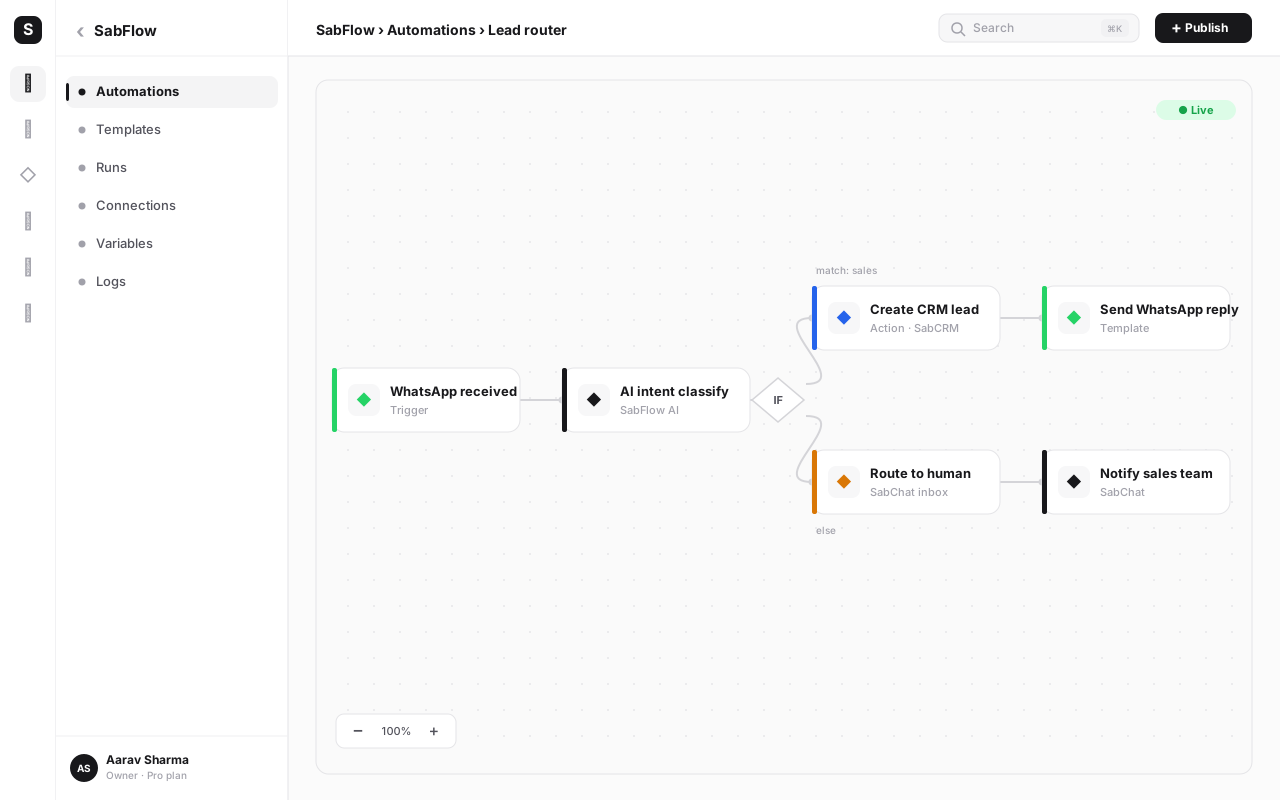
2. Automation kicks in. A SabFlow workflow fires: it uses an AI node to classify the message intent, creates a lead in SabCRM, and routes the conversation to the right agent in SabChat.
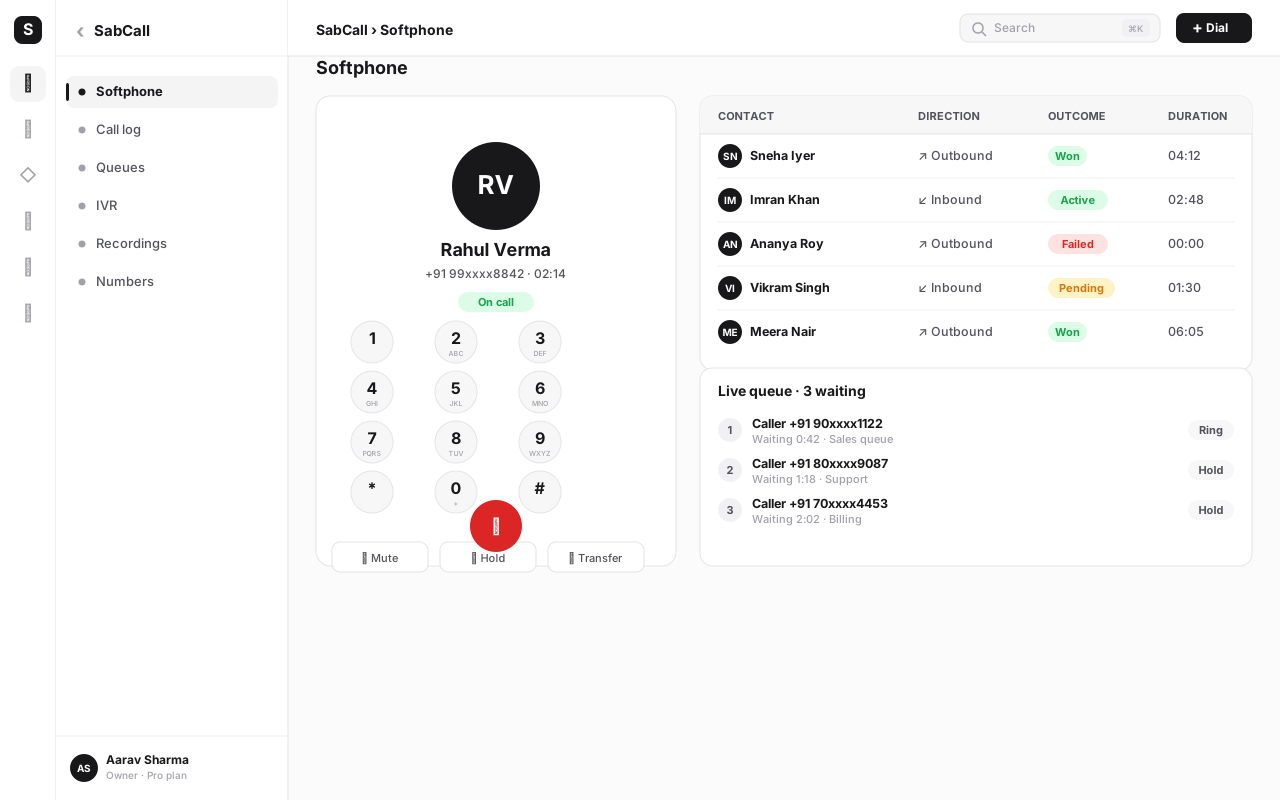
3. A human takes over. Your agent sees the full context, replies on WhatsApp, and clicks "Call" to dial the lead through SabCall — the call is recorded and logged to the same contact.
4. The deal moves. The agent updates the deal stage in SabBigin's pipeline, sends a quote, and triggers an SabSign document for the customer to sign.
5. Payment. Once signed, a SabPay payment link is sent over WhatsApp; the customer pays by UPI in two taps, and the payment is reconciled against the deal.
6. It’s all measured. SabNode rolls every step into dashboards: conversion rate by channel, response time, revenue by source.
At no point did anyone export a CSV, paste a phone number into a different app, or wonder "did someone already follow up?" That continuity is the product.
When an all-in-one platform is the right call (and when it isn't)#
Consolidation is powerful, but it's not automatically right for everyone at every moment. Be honest about your situation.
A useful rule of thumb: consolidate when context is getting lost, not when you have the fewest apps. If your team regularly asks "where's that conversation?" or "did we already call them?", the cost of fragmentation has arrived and a platform will pay for itself. If you're a one-person shop with a single channel, you may not feel the pain yet.
The other crucial test is depth. A real all-in-one platform has genuine, capable modules — a CRM you'd be happy to use on its own, a calling system that handles IVR and queues, automation that rivals a dedicated tool. A weak "bundle" of shallow features is a downgrade. When you evaluate, push on each module as if you were buying it standalone.
Don't be seduced by a long feature list. Ask to actually run the modules you'll lean on most. One excellent CRM and one excellent inbox beat ten mediocre tools wearing a trench coat.
How to evaluate an all-in-one platform: a buyer's checklist#
Use this when you compare options. The best platform is the one that scores well on the jobs you do most, not the longest list.
- Shared data, not just shared login. Does a call placed in the calling module appear on the CRM contact automatically? If modules don't share data, it's a bundle, not a platform.
- Module depth. Rate each core module as if buying it alone. Would you?
- Cross-module automation. Can a payment trigger a WhatsApp message? Can a new lead start a call sequence? This is where compounding value lives.
- Channel coverage for your market. In India, that means WhatsApp Business API onboarding, DLT-compliant SMS and UPI payments — first-class, not bolted on.
- Roles and governance. Granular permissions, audit logs and SSO if you're a team.
- Migration path. Import from spreadsheets and your current tools; an API for the rest.
- Pricing model. One predictable bill that scales with usage — and a free or low tier to start.
- Support and reliability. One vendor accountable for uptime across everything.
The cost case, honestly#
The financial argument for consolidation is real but often overstated, so here's the honest version.
The obvious saving is subscriptions: replacing eight tools with one usually lowers the monthly software bill, especially once you account for per-seat licences multiplied across products. But the bigger saving is operational. When data flows automatically, you stop paying people to move it. A salesperson who isn't re-typing phone numbers into a dialer is selling. A support agent who has full context resolves tickets faster and answers fewer "can you remind me what you ordered?" questions.
There's also a revenue side that rarely shows up in a spreadsheet: faster response times and no dropped follow-ups directly increase conversion. The lead you call back in two minutes instead of two hours is far more likely to buy.
The cost to weigh against all that is migration effort and the switching risk of putting more of your operation with one vendor. Both are manageable — phased migration and good import tooling de-risk the move — but they're real, and a good platform should help you through them rather than pretend they don't exist.
See your whole business in one platform
Bring WhatsApp, calls, CRM, SMS, automation and payments onto one customer timeline. Start free and add modules as you grow — no credit card required.
Where AI fits in an all-in-one platform#
The newest reason consolidation is winning is AI — and AI is dramatically more useful when it can see all your data in one place. An AI assistant that only sees your email is limited. One that can see the WhatsApp chat, the call transcript, the CRM stage and the payment history can actually help: draft a reply with full context, summarise a long conversation, classify and route incoming messages, flag at-risk deals, or write the follow-up.
Across SabNode, AI shows up inside the modules — intent classification and reply suggestions in the inbox, AI nodes in SabFlow automations, summarisation in the CRM. Because everything runs on one data model, the AI isn't guessing from a fragment; it's reasoning over the whole customer relationship. That's a structural advantage point tools simply can't match.
Security, governance and one source of truth#
Consolidation has a quieter benefit that matters enormously once you have more than a handful of people: governance. When customer data is spread across ten tools, your security posture is only as strong as the weakest of them, and answering a simple question — "who can see customer phone numbers?" — means auditing ten different permission systems.
On one platform, governance is unified. You define roles once, and they apply across every module: a junior agent can reply to WhatsApp chats but not export the contact database; a finance user can issue refunds in payments but can't change CRM pipelines; an owner sees everything. Audit logs capture who did what across the whole system, not in ten disconnected logs. Access reviews, offboarding a departing employee, and proving compliance to a customer or auditor all become a single, coherent task instead of ten.
| Governance concern | Ten-tool stack | One platform |
|---|---|---|
| Permissions | Configured separately in each tool | One role model across all modules |
| Offboarding a user | Revoke access in ten places | Deactivate once |
| Audit trail | Ten partial logs | One unified activity log |
| Data residency | Varies per vendor | One posture to verify |
| Security surface | Ten vendors to trust | One vendor accountable |
For Indian businesses thinking about data protection obligations under the DPDP Act, having one system of record — rather than customer data scattered across providers you'd struggle to even list — is a meaningful simplification. You can read more about how the pieces fit in the CRM software guide, which goes deeper on roles and the contact data model.
What a 90-day consolidation looks like#
The single biggest mistake teams make is trying to switch everything in a weekend. A phased, 90-day rollout de-risks the move and lets you prove value at each step before going further. Here's a realistic sequence.
- Weeks 1–2: Foundation. Create your workspace, invite your team with the right roles, and connect your most-used channel first — usually WhatsApp. Import your contacts and clean up duplicates as you go.
- Weeks 3–4: The system of record. Set up your CRM pipelines and stages to match how you actually sell, and start logging every conversation to contacts. Don't customise endlessly — start simple and refine.
- Weeks 5–6: Add a second channel. Bring calling or SMS onto the platform so more interactions land on the same timeline. Now the unified-history benefit becomes visible to the whole team.
- Weeks 7–8: Automate one painful process. Pick the most repetitive hand-off you have — say, routing new leads — and build it in SabFlow. One good automation converts skeptics.
- Weeks 9–10: Money and documents. Add payments and e-signatures so deals can close end to end without leaving the platform.
- Weeks 11–12: Measure and expand. Stand up dashboards, review what's working, and retire the old tools you've now replaced — cancelling those subscriptions is the moment the cost case becomes real.
If you're a larger organisation, run the 90-day rollout with a single team or department before going company-wide. A successful pilot gives you a template — and internal champions — for the broader migration.
Common mistakes when moving to one platform#
- Migrating everything at once. Start with the core (channels + CRM), prove it, then move the rest. A phased rollout beats a risky big-bang.
- Skipping data clean-up. Consolidation is the perfect moment to de-duplicate contacts and fix tags. Import messy, stay messy.
- Not redesigning workflows. Don't just recreate your old siloed process. The win is the automations you couldn't build before — use them.
- Under-investing in team training. One system is easier to learn than ten, but people still need a guided first week. Budget for it.
- Choosing on feature count. Choose on the depth of the two or three modules you'll live in every day.
Conclusion#
An all-in-one business platform isn't about owning fewer apps for its own sake. It's about giving every customer one continuous story that your whole team can see and act on — and giving yourself automation, AI and reporting that only become possible when the data lives together. For most small and growing businesses, that continuity is the difference between feeling scattered and feeling in control.
If your team is losing context between tools, the consolidation question has already answered itself. The next step is to evaluate platforms on the depth of the modules you actually use, the way they share data, and how well they fit your market. SabNode is built to win that evaluation — explore the products, compare the pricing, read what SabNode actually is if you're just getting oriented, see how it compares to Zoho One if you're weighing a bundled suite, or read the omnichannel engagement guide to go deeper on the channel layer.
Frequently asked questions
What is an all-in-one business platform?
An all-in-one business platform is a single piece of software that combines the tools a business uses to find, talk to, sell to and support customers — channels like WhatsApp, calling, SMS and email, plus a CRM, automation, payments and reporting — behind one login and one bill. Instead of stitching five or ten separate apps together, every customer interaction lives on one shared timeline.
Is an all-in-one platform better than best-of-breed tools?
It depends on your stage. Small and growing teams usually win with an all-in-one platform because it removes integration cost, duplicate data and per-seat sprawl, and gives one view of the customer. Large enterprises with specialised needs sometimes keep a few best-of-breed tools, but even they consolidate the core (channels + CRM + automation) to cut hand-offs.
Does SabNode replace my CRM?
Yes. SabNode includes a full CRM (SabCRM) with leads, contacts, pipelines, custom objects, automation and reporting. Because the CRM sits in the same platform as your WhatsApp, calls and payments, every conversation and transaction is logged to the contact automatically — no sync, no import.
Is SabNode suitable for small businesses in India?
Yes. SabNode is built India-first — DLT-compliant SMS, WhatsApp Business API onboarding, UPI payments and rupee billing — and is used by small and mid-size businesses across e-commerce, real estate, clinics, coaching and services. You can start on a free plan and add modules as you grow.
How long does it take to set up an all-in-one platform?
Core setup — creating your workspace, connecting WhatsApp, importing contacts and inviting your team — typically takes an afternoon. Channels that need provider approval, like the WhatsApp Business API or DLT-registered SMS sender IDs, can take a few business days for verification, which you can run in parallel.
Will moving to one platform mean losing my existing data?
No. SabNode imports contacts, deals and message history from spreadsheets and most popular tools, and offers an API and webhooks for anything custom. The goal of consolidation is to bring your data together, not to leave it behind.