Omnichannel Customer Engagement, Unified
WhatsApp, chat, SMS, email and voice that remember each other. Here's what omnichannel customer engagement really means, how it differs from multichannel, and how to build it on one CRM timeline.
Omnichannel customer engagement is an approach where every channel a customer uses — WhatsApp, live chat, SMS, email and voice — shares the same record, history and context. The customer moves between channels without repeating themselves, and every agent sees one continuous timeline. It treats the customer as one person across all touchpoints, not a new stranger on each one.
That single sentence hides a lot of work. Most businesses think they're "omnichannel" because they're reachable on five channels — but five inboxes that don't talk to each other isn't omnichannel, it's just busy. This guide explains the difference precisely, walks through the channels and the one piece that ties them together, and shows you how to build, orchestrate and measure a real omnichannel setup. We'll use SabNode as the worked example, because its modules are designed to share one customer timeline.
What omnichannel customer engagement actually means#
The word "omnichannel" gets stretched to mean almost anything, so let's pin it down. Omnichannel describes a model where a customer's experience is continuous and consistent no matter which channel they're on, because every channel draws from and writes to the same underlying record of that customer.
Concretely, three things have to be true:
- One identity. A customer who WhatsApps you on Monday, calls on Tuesday and emails on Wednesday is recognised as the same person every time — not three separate contacts in three separate tools.
- One context. Whoever handles the next interaction can see everything that came before it, across every channel, without asking the customer to explain again.
- One consistent experience. The tone, the information, the offers and the status of the customer's issue are the same whether they reach you on chat or on a call. They never get two contradictory answers.
When those three hold, the customer stops thinking about "channels" at all. They just feel like they're talking to one business that knows them. That feeling — continuity — is the entire product of omnichannel, and everything else in this guide is in service of it.
Here's a small Indian SMB scenario that makes it concrete. A customer of a Pune-based home-appliance retailer messages on WhatsApp asking about a washing machine, gets a quote, calls the next day with a question about installation, and finally emails to confirm the order. In a true omnichannel setup, the sales agent who picks up the call already sees the WhatsApp quote on screen and the email lands on the same customer record, against the same deal. The customer never repeats their model number, their pincode or their budget. That's omnichannel.
Omnichannel vs multichannel: the difference that matters#
This is the distinction most teams get wrong, and it's worth being blunt about. Being on many channels is multichannel. Making those channels share one identity, timeline and context is omnichannel. The first is about reach; the second is about continuity.
A useful image: multichannel is many separate doors into the same building, with no hallway connecting the rooms behind them. A customer who walks through the WhatsApp door and then the phone door enters two different rooms, each staffed by people who've never met and don't share notes. Omnichannel is one building where every room shares the same memory of who just walked in.
| Dimension | Multichannel | Omnichannel |
|---|---|---|
| Customer identity | Separate per channel | One identity across all channels |
| Conversation history | Trapped in each channel's inbox | One shared timeline |
| Context on handoff | Lost — customer repeats themselves | Carried — agent sees everything prior |
| Team structure | Siloed teams per channel | Shared queue, shared view |
| Experience consistency | Varies by channel and agent | Consistent everywhere |
| Data & reporting | Per-channel, hard to combine | Unified, end-to-end |
| System of record | None, or one per tool | One CRM for everyone |
The reason this matters isn't pedantic. Multichannel quietly feels like progress — you added WhatsApp, you added live chat, the dashboards look busier — while the customer's actual experience degrades. The more channels you add without connecting them, the more often the customer has to repeat themselves, and the more often two agents give conflicting answers. Adding channels without joining them makes the problem worse, not better.
Pick any customer. Can an agent on any channel, in under ten seconds, see every message, call and email that customer has ever had with you — across all channels — without leaving their screen? If yes, you're omnichannel. If they have to open another tool, ask a colleague, or ask the customer to repeat themselves, you're multichannel wearing an omnichannel label.
The channels of an omnichannel setup#
Omnichannel doesn't mean "every channel that exists." It means the channels your customers actually use, all connected to one record. For Indian SMBs, the practical set is well established, and SabNode provides a module for each.
| Channel | SabNode module | Best for |
|---|---|---|
| WaChat | Primary conversational channel — support, sales, broadcasts | |
| Live chat | SabChat | Website and in-app visitors, real-time questions |
| SMS | SabSMS | OTP, transactional alerts, reach where data is patchy |
| SabMail | Longer messages, records, formal confirmations | |
| Voice | SabCall | High-value or complex conversations, closing deals |
| Social DMs | WaChat / SabChat | Instagram and Facebook messages from campaigns |
Each channel has a job it does best, and the art of omnichannel is letting the customer (and the moment) choose, while you keep one continuous record underneath.
- WhatsApp is, for most Indian businesses, the centre of gravity. It's where customers are most comfortable, it carries rich media, and the WhatsApp Business API supports templates, catalogs and automation at scale. WaChat handles inbound conversations and outbound broadcasts on the same number.
- Live chat catches people at the moment of highest intent — on your pricing page, in your app. SabChat's shared inbox and widget let a visitor start a conversation that can later continue on WhatsApp or a call without breaking.
- SMS is the workhorse for reach and reliability. It needs no app, no data, and it's the backbone for OTP and time-critical alerts. SabSMS handles DLT-compliant business SMS for India.
- Email is for the things customers want a record of: invoices, confirmations, detailed quotes. SabMail keeps that on your own domain and on the same timeline.
- Voice still closes deals and resolves the hard cases. A cloud calling system like SabCall lets an agent dial a customer straight from their record, with the call recorded and logged back automatically.
The point isn't to use all of them for everything. It's that whichever one the customer picks, the conversation lands in the same place.
The single customer timeline: the backbone#
Here's the part everything depends on. The thing that turns five channels into one omnichannel experience is not the channels — it's the shared timeline behind them. Strip away the marketing and omnichannel is simply this: every interaction, on every channel, is written to one customer record in one CRM, in chronological order, visible to everyone who needs it.
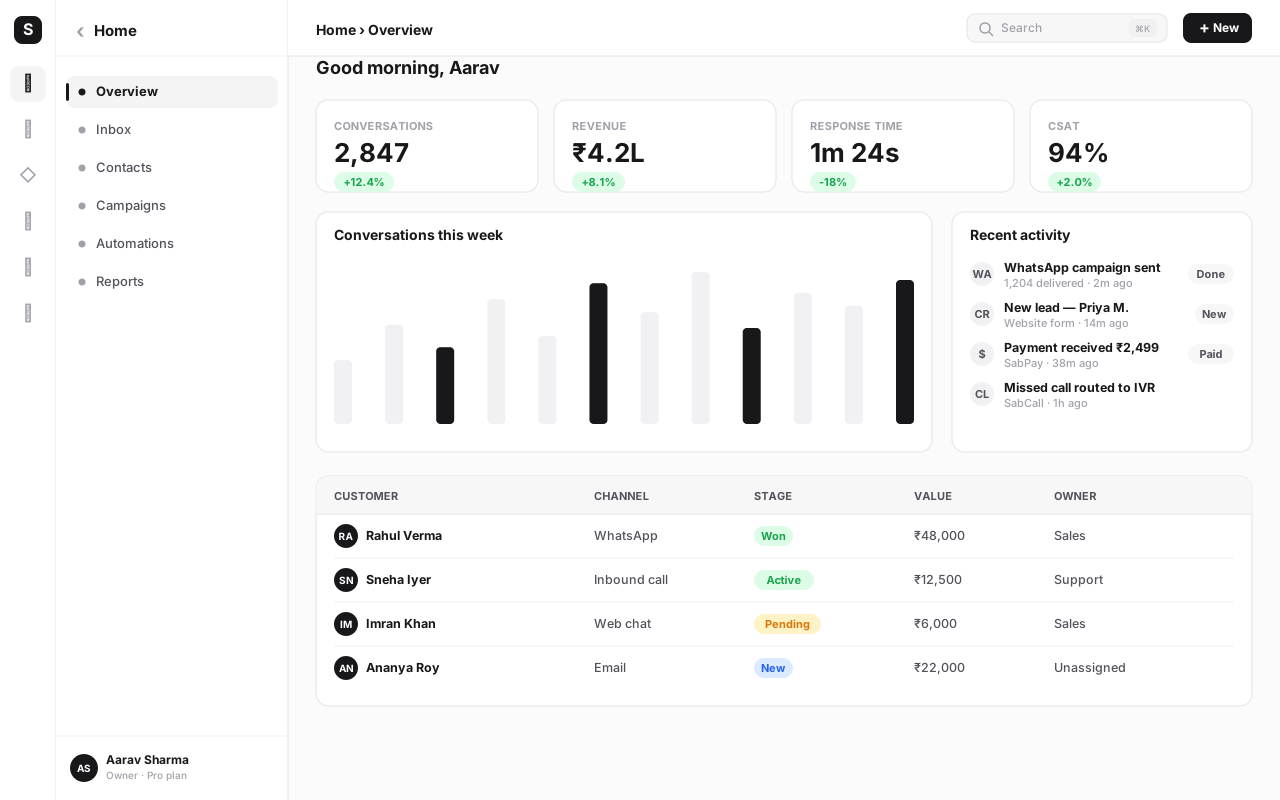
When that timeline exists, a few things become possible that were impossible before:
- An agent answering a WhatsApp message can see that the customer called yesterday and what was said.
- A salesperson about to dial a lead can read the entire chat history first, so the call opens with context instead of "so, what was this regarding?"
- A support manager can look at one customer and understand the whole relationship — every channel, every touch — at a glance.
Without that backbone, you can have the best individual tools in the world and still deliver a fragmented experience, because no one ever sees the whole picture. With it, even a small team feels organised and attentive, because everyone is working from the same memory.
In SabNode, that backbone is the CRM. WaChat, SabChat, SabCall, SabSMS and SabMail all log to it automatically — there's no sync job, no nightly export, no integration to maintain. A WhatsApp message, a missed call, a delivered SMS and an opened email all appear on the same contact, in order, the moment they happen. That automatic, shared write is the single most important property of an omnichannel platform, and it's the thing thin "bundles" of disconnected tools can't replicate.
Connecting five separate tools with integrations looks like omnichannel, but it's fragile. Connectors break, data drifts out of sync, and there's always a delay and a field that didn't map. A genuine shared timeline comes from channels built on one data model — not five products stitched together with webhooks you have to babysit.
Routing a customer across channels without losing context#
The moment that separates real omnichannel from the pretenders is the handoff — when a customer switches channels, or your business switches them, mid-issue. Get this right and the rest follows.
Consider a Bengaluru coaching institute. A prospective student fills out a web form, gets a WhatsApp message with course details, replies with questions, and then asks to "just talk to someone." In a siloed setup, the counsellor who calls has none of that history; the student re-explains which course, which batch, which budget — and half the time something gets lost. In an omnichannel setup, the counsellor opens the student's record, sees the form, the WhatsApp thread and the questions already asked, and opens the call with "Hi Priya, I see you're looking at the weekend data-science batch and asked about the EMI option — let me walk you through that." That's the difference a carried context makes.
To make handoffs seamless, three things have to travel with the customer:
- Identity — the same phone or email resolves to the same contact, so switching from chat to call doesn't create a new record.
- History — the prior messages and calls are visible on the new channel immediately.
- State — where the customer is in their journey (which deal stage, which open ticket) is known, so the new interaction continues rather than restarts.
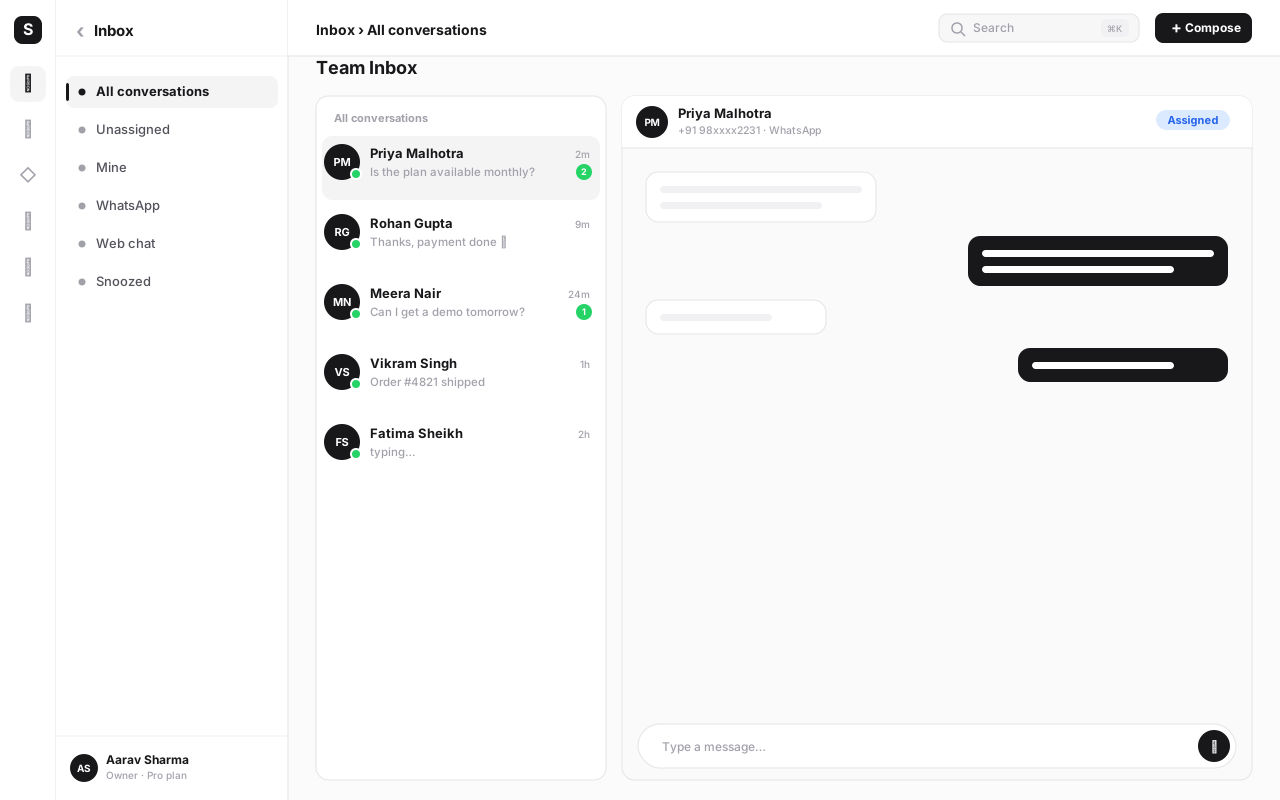
Because SabNode's channels share one contact record, all three travel automatically. A conversation that starts in SabChat and moves to a SabCall dial-out stays on the same timeline; an agent picking up a WhatsApp thread sees the call that happened an hour earlier. The customer experiences one conversation that happens to cross channels — which is exactly what "omnichannel" should feel like.
Consistent identity and history across every channel#
Continuity rests on identity resolution — reliably knowing that the person on this channel is the same person you've spoken to before. It sounds simple, but it's where multichannel setups quietly fall apart: the same customer becomes "9876543210" in the calling tool, "priya@gmail" in the email tool, and "Priya S." in the chat app, and no one realises they're one person.
A real omnichannel platform solves this by making the CRM contact the anchor. Phone numbers, email addresses and chat handles all attach to one contact, so any new interaction matches back to the existing person. The benefits compound:
- No duplicate records. One customer, one history, one source of truth.
- No "have we spoken before?" The full relationship is always visible.
- Personalisation that's actually personal. You can reference real past interactions because you can see them.
When identity is consistent, history becomes a continuous story instead of disconnected fragments — and that story is what lets you treat a returning customer like a returning customer, not a cold lead. For teams running a shared inbox, this is what stops two agents from unknowingly working the same person on two different channels.
Orchestrating journeys with automation#
Omnichannel isn't only about reacting to whichever channel a customer picks. It's also about proactively reaching them on the right channel at the right moment — and that's where automation turns a collection of channels into an orchestrated journey.
Orchestration means designing the path a customer takes and letting software move them along it across channels. A classic Indian e-commerce flow looks like this:
- Order confirmed → SMS with the order number (instant, no data needed).
- Shipped → WhatsApp message with tracking and a live link.
- Delivered → WhatsApp asking for a rating, with a one-tap reply.
- No rating after two days → gentle email follow-up.
- Customer replies with a complaint on any channel → automatically routed to a human agent with full context.
In SabNode, SabFlow is the no-code engine that orchestrates this. A single workflow can listen for an event on one channel, decide the next best channel, send the message, wait, branch on the response, and hand off to a person when judgment is needed — all while writing every step to the same customer timeline. The customer experiences a coherent journey; behind the scenes it's one automation reaching across five modules.
The discipline that makes orchestration work is channel etiquette: use SMS for time-critical and transactional, WhatsApp for conversational and rich, email for records and detail, voice for high-value and complex. Automation should respect the customer's preferences and not blast every channel at once. Orchestration done well feels considerate; done badly it feels like being chased.
Personalisation on top of a unified record#
Personalisation is often reduced to "Hi {{first_name}}," but real personalisation is impossible without the unified record omnichannel gives you. When every interaction lives on one timeline, you can tailor the content, the timing and the channel to each customer because you actually know them.
That unlocks things that feel genuinely attentive:
- Referencing a customer's last order or last conversation, regardless of which channel it happened on.
- Reaching out on the channel a particular customer actually responds to, instead of your default.
- Skipping the upsell to someone who just raised a complaint — because the complaint is right there on the timeline.
- Segmenting by real behaviour across channels, not by a single tool's narrow view.
The unified timeline is the raw material; personalisation is what you make from it. A business that can see a customer's full history can make every message feel like a continuation of a relationship rather than a broadcast to a stranger — and that, far more than a merge field, is what customers register as being treated as a person.
How to build an omnichannel setup: a step-by-step walkthrough#
Here's a practical sequence for standing up omnichannel engagement on one platform. You don't need every channel from day one — you need the backbone, then channels added onto it.
- Make the CRM your system of record first. Before adding channels, decide that one CRM holds the truth about every customer. In SabNode this is built in — the CRM is where every module writes. Import and de-duplicate your existing contacts so you start with clean, single identities.
- Connect your primary channel. For most Indian businesses that's WhatsApp. Onboard the WhatsApp Business API through WaChat and confirm that inbound messages land on the matching CRM contact automatically.
- Add live chat. Put the SabChat widget on your website and in your app, and route those conversations into the same shared inbox and timeline as WhatsApp, so a visitor's chat and a later WhatsApp message join the same record.
- Layer in SMS and email. Connect SabSMS (DLT-registered for India) for transactional and time-critical messages, and SabMail on your own domain for records and detail. Verify that both log to the contact.
- Add voice. Bring SabCall online so agents can dial a customer straight from their record. Confirm calls and recordings write back to the timeline automatically.
- Unify the team's view. Put your agents into one shared inbox where conversations from every channel appear together, with assignment, internal notes and the full customer history visible on each one.
- Resolve identity across channels. Ensure phone, email and chat handles all attach to one contact so the same person is never split into duplicates. Spot-check a few real customers.
- Orchestrate journeys with SabFlow. Build your first cross-channel automation — for example, the order-to-rating flow above — that decides the next-best channel and hands off to a human when needed.
- Define channel etiquette. Write down which channel is used for what, and the tone and SLA for each, so the experience is consistent across agents and automations.
- Instrument and measure. Turn on reporting so you can see first response, resolution, CSAT and channel mix from the start. You can't improve what you don't measure.
Done in this order, you build the hallway before the doors — the shared record first, then each channel connecting into it — which is precisely what keeps you on the omnichannel side of the line.
Put every channel on one customer timeline
WhatsApp, live chat, SMS, email and voice — all logging to one CRM, all visible to your whole team. Start free and add channels as you grow.
Measuring omnichannel engagement#
You can't manage omnichannel with per-channel dashboards, because the whole point is that customers cross channels. You have to measure the experience end to end. A handful of metrics matter most.
| Metric | What it tells you | How to read it |
|---|---|---|
| First response time | How fast you acknowledge a customer | Measure across all channels combined, not per inbox |
| Resolution time | How long to fully close an issue | Track even when the issue crosses channels mid-way |
| CSAT | Whether the customer felt well served | Watch whether it holds steady as customers switch channels |
| Channel mix | Where conversations start and finish | Reveals which channels do which jobs for your audience |
| Channel-switch rate | How often one issue spans channels | High switching with stable CSAT = handoffs are working |
| Repeat-context rate | How often customers re-explain themselves | Should trend toward zero — it's the omnichannel failure signal |
The headline signal of a working omnichannel setup is counter-intuitive: resolution time and CSAT should hold or improve even as channel-switching goes up. If customers move across more channels but still get resolved fast and stay satisfied, your handoffs are carrying context. If satisfaction drops every time someone switches channels, context is leaking somewhere and you have a multichannel problem dressed up as omnichannel.
Because SabNode's channels share one data model, SabNode can report on all of this together — first response across every channel, resolution that spans a chat-to-call journey, CSAT by channel and overall. You see the customer's whole experience, not six disconnected scorecards.
The role of one CRM#
Everything in this guide collapses to a single requirement: one CRM acting as the system of record. It is the non-negotiable foundation, and it's worth saying plainly because it's where most omnichannel efforts succeed or fail.
The CRM is what holds the one identity, the one timeline and the one context that the channels read from and write to. Take it away and each channel keeps its own version of the customer, and you're back to multichannel silos no matter how many tools you've connected. The channels are spokes; the CRM is the hub. A spoke with no hub is just another silo.
This is why an all-in-one platform has a structural advantage over a stack of best-of-breed point tools for omnichannel specifically. When the channels and the CRM are the same platform, the shared timeline is automatic — there's nothing to integrate, nothing to sync, nothing to drift. When they're separate products, you spend forever trying to recreate the shared record with connectors, and you never quite get there. SabNode is built the first way: WaChat, SabChat, SabCall, SabSMS and SabMail are channels on one CRM, so the omnichannel timeline isn't a feature you assemble — it's how the platform works by default.
Common mistakes when going omnichannel#
- Adding channels without connecting them. The most common mistake by far. More channels without a shared timeline makes the experience worse, because customers repeat themselves more often. Build the backbone first.
- Treating omnichannel as a tool-buying exercise. It's an operating model, not a shopping list. Buying five channel tools and calling it omnichannel misses the entire point — the connection is the product.
- Letting identity fragment. If the same customer becomes three records in three tools, every other benefit evaporates. Resolve identity to one contact and protect it.
- Forcing customers onto your preferred channel. Omnichannel means meeting customers where they are, not herding everyone to the channel that's easiest for you. Respect their preference.
- Blasting every channel at once. Orchestration is about the right channel at the right moment, not all of them simultaneously. Coordinated beats loud.
- Measuring channel by channel. Per-channel dashboards hide the cross-channel journeys that matter. Measure the experience end to end or you'll optimise the wrong things.
- Ignoring the handoff. The moment a customer switches channels is where context is most likely to be lost — and it's the exact moment omnichannel is supposed to shine. Test your handoffs with real customers.
Conclusion#
Omnichannel customer engagement isn't about being everywhere. It's about being one business everywhere — recognisable, consistent and continuous no matter which channel a customer chooses. The difference between that and ordinary multichannel comes down to a single thing: whether your channels share one identity, one timeline and one context, or run as separate silos that happen to share a logo.
The path to real omnichannel is clear. Make one CRM your system of record, connect your channels so they all write to it, resolve identity to one contact, orchestrate journeys with automation, and measure the experience end to end. Do that and even a small Indian SMB can deliver the kind of attentive, joined-up experience that customers usually only expect from far larger companies — because the customer stops thinking about channels and just feels known.
That's exactly what SabNode is built to deliver: WhatsApp, chat, SMS, email and voice as modules on one shared CRM, orchestrated by SabFlow and measured end to end — five channels that behave like one continuous conversation. To see how the pieces fit into a single platform, start with the all-in-one platform guide, or explore the products and check the pricing when you're ready to build your own omnichannel setup.
Frequently asked questions
What is omnichannel customer engagement?
Omnichannel customer engagement is a way of talking to customers in which every channel — WhatsApp, live chat, SMS, email and voice — shares the same customer record, history and context. A customer can move from a WhatsApp message to a phone call to an email and never repeat themselves, because every team and tool sees the same continuous timeline. It treats the customer as one person across all touchpoints, not a fresh stranger on each channel.
What is the difference between omnichannel and multichannel?
Multichannel means you are present on many channels, but each one runs in its own silo with its own inbox, history and team. Omnichannel means those channels share one identity, one timeline and one context, so the experience is consistent and continuous as the customer moves between them. Multichannel is many doors into the same building with no hallway connecting them; omnichannel is one building where every room shares the same memory of the customer.
Which channels should an omnichannel strategy include in India?
For most Indian businesses the core set is WhatsApp (usually the primary channel), live chat on the website and app, transactional and promotional SMS, email, and voice calling, with social DMs added where relevant. The exact mix depends on your audience, but WhatsApp and SMS are almost always foundational in India because of reach, and voice still closes high-value deals. What matters more than the list is that all of them write to one customer record.
How do you measure omnichannel engagement?
Measure it end to end, not channel by channel. The core metrics are first response time, full resolution time, CSAT or customer satisfaction, channel mix (where conversations start and where they finish), and the rate of channel switching within a single issue. The real signal of a working omnichannel setup is that resolution time and CSAT improve even as customers move across more channels, because context is never lost in the handoff.
Do I need a single CRM to do omnichannel properly?
Practically, yes. Omnichannel depends on a single shared record of each customer that every channel reads from and writes to. Without one CRM acting as the system of record, each channel keeps its own version of the customer and you are back to multichannel silos. The CRM is the backbone; the channels are spokes that all connect to it, so any agent on any channel sees the full history.
How is SabNode built for omnichannel engagement?
SabNode runs WaChat (WhatsApp), SabChat (live chat and shared inbox), SabCall (voice), SabSMS and SabMail as modules on one shared CRM, so every message, call and email is logged to the same contact automatically — no syncing, no exports. SabFlow orchestrates journeys across those channels with no-code automation, and built-in reporting covers the whole experience. That shared data model is what turns five channels into one omnichannel experience instead of five inboxes.