WhatsApp Business API for Real Estate: Leads, Listings and Follow-Up
A property lead that waits an hour is often a lost lead. Here's how real estate teams use WhatsApp for instant response, listing shares and follow-up that doesn't drop the ball.
A property lead that isn't contacted within minutes is, in practice, a lead that's already talking to a competitor. The WhatsApp Business API lets real estate teams respond to portal and ad leads instantly, capture requirements through structured in-chat forms, share listings and brochures without switching apps, and log every conversation to a CRM record — turning a channel buyers already trust into the fastest first-response tool a brokerage has.
Why real estate is a near-perfect fit for WhatsApp#
Real estate has three properties that make WhatsApp unusually effective compared to most other verticals: leads are extremely time-sensitive, buyers do most of their early research after work hours on their phone, and the sales cycle involves sharing a lot of visual and document-heavy content — photos, floor plans, walkthrough videos, brochures — that a chat thread handles far better than a phone call ever could.
Consider what a typical portal-generated lead looks like. A buyer is scrolling listings on their phone at 9 p.m., taps "Enquire" on a 3BHK in Whitefield, and either fills a short form or clicks a WhatsApp icon. If the response is an email the next morning, or even a call two hours later, that buyer has usually already messaged three other agents and may have moved on emotionally from the listing that first caught their eye. If the response is a WhatsApp message within a minute or two — "Hi, thanks for your interest in the 3BHK on Example Road, is this still the budget range and locality you're looking at?" — the conversation continues in the same moment of interest that generated the lead in the first place.
Nothing else on this page matters as much as this: real estate leads are famously time-sensitive, and a lead not contacted within minutes converts at a sharply lower rate than one contacted immediately. Every tactic below — Flows, catalog shares, broadcasts, CRM logging — is in service of getting a fast, relevant first reply and then not dropping the thread afterward.
WhatsApp's near-universal adoption in India means it's also simply where buyers already are. Asking someone to download a separate app, fill a portal's contact form, or wait for a scheduled call adds friction that a WhatsApp message doesn't have — the reply comes back inside an app the buyer already checks dozens of times a day.
Where real estate leads actually come from#
Before automating anything, it helps to map the channels a brokerage typically pulls leads from, because each one can be wired into WhatsApp slightly differently.
| Source | Typical lead behaviour | How WhatsApp fits in |
|---|---|---|
| Property portals (99acres, MagicBricks-style listings, Housing.com-style listings) | Buyer fills an enquiry form against a specific listing | Auto-reply on WhatsApp within seconds, referencing the exact listing they enquired about |
| Click-to-WhatsApp ads (Facebook/Instagram) | Buyer taps an ad and lands directly in a chat, already primed to type | No landing page or form — the ad opens the conversation itself |
| Website enquiry forms | Visitor submits a callback request from the brokerage's own site | Form submission triggers an instant WhatsApp message instead of a queued email |
| Referrals and walk-ins | Existing client refers a buyer, or someone walks into a project site office | Agent manually starts (or continues) the WhatsApp thread and logs it the same way as any other lead |
| Existing database / repeat buyers | Past enquirers or clients who opted in to updates | Segmented nurture broadcasts for genuinely relevant new listings only |
The common thread: whichever channel the lead arrives from, the goal is the same — get a relevant WhatsApp message in front of the buyer immediately, and make sure that conversation is attached to a CRM record from the first message onward, not just living in an agent's personal phone.
Instant response: turning a portal click into a conversation#
The mechanics of "instant response" are worth being specific about, because the value is almost entirely in the first two minutes.
Click-to-WhatsApp ads are the cleanest version of this. Instead of a Facebook or Instagram property ad sending a viewer to a landing page with a lead-capture form — which the viewer may abandon, may fill with a wrong number, or may simply close the tab on — the ad opens a WhatsApp conversation directly with the agent's or brokerage's WhatsApp Business number. The buyer is already mid-conversation before they've had a chance to lose interest, and because they typed the first message themselves, there's no "cold" lead-quality question the way there often is with a form submission.
Portal-integrated auto-reply covers the more common case, where the lead still originates on a third-party portal. The moment that enquiry reaches the brokerage (typically as an email or a webhook), an automation can fire an instant WhatsApp message to the buyer referencing the specific listing, before a human agent has even seen the notification. That first message doesn't need to close anything — it just needs to confirm receipt, keep the buyer's attention, and start the qualification conversation while the intent is still fresh.
Because the first WhatsApp message often has to fire before a human has read the lead, it's usually sent as an approved template ("Thanks for your interest in [listing] — an agent will help you find the right fit. Quick question to start: what's your budget range?"). Keep it short, reference the specific listing, and hand off to a human or a Flow immediately after — the goal is acknowledgement, not a scripted sales pitch.
Capturing requirements with WhatsApp Flows#
A huge amount of the early real estate conversation is repetitive: what's your budget, which locality, how many bedrooms, when do you want to move in. Doing this as a typed back-and-forth is slow for the buyer and inconsistent for the agent — some questions get skipped, answers get buried in a long thread, and nothing is captured as clean data.
This is exactly the job a WhatsApp Flow is built for. A Flow is a structured, native form that opens inside the chat itself — no redirect to an external website, no separate app. For a real estate lead, a single Flow can walk the buyer through:
- Budget range (a constrained slider or dropdown, not free text)
- Preferred locality or micro-market
- Configuration — 1BHK, 2BHK, 3BHK, plot, commercial
- Timeline to move or invest
- Preferred site-visit day and time slot
In practice, most brokerages use both: a Flow for the first structured pass on a new lead, and normal chat once an agent is actively working the relationship. The Flow does the heavy lifting of turning "hi, interested in the 3BHK" into a qualified record with budget, locality, configuration and timeline already sitting as structured fields on the CRM lead — no agent has to re-type any of it.
Sharing listings, brochures and virtual tours in-chat#
Once requirements are captured, the next job is showing the buyer options — and this is where WhatsApp's media handling genuinely beats a phone call or a plain SMS. A single conversation can carry:
- Photos of shortlisted units, sent as a simple album rather than a portal link the buyer has to click through
- Video walkthroughs, which let a buyer get a real sense of a property before committing to a site visit — especially valuable for NRI or out-of-city buyers
- Floor plans and brochures as PDF documents, sent as document-header templates so they arrive as a proper file rather than a low-resolution screenshot
- A catalog of multiple listings that match the captured budget and locality, so the buyer can browse a shortlist inside the same chat instead of juggling portal tabs
This matters because real estate decisions are visual and document-heavy in a way few other purchases are — a buyer wants to see the kitchen, check the carpet area on the floor plan, and compare two or three options side by side before agreeing to drive across town for a site visit. Doing all of that inside the same thread where the requirement conversation already happened keeps everything in one continuous context, instead of scattering photos across email, a phone gallery shared over a call, and a PDF that got lost in someone's downloads folder.
The goal of sharing photos, videos and floor plans in-chat isn't to close the sale remotely — it's to give the buyer enough confidence to book (and show up for) a site visit. Treat every media share as a step toward a scheduled visit, and make booking that visit the natural next action in the same conversation, ideally through the same Flow that captured requirements.
Nurture broadcasts for a warm database — with a hard caveat#
Not every lead is ready today. A buyer who enquired about a 2BHK in a project still six months from possession, or someone who liked a listing that later sold, still belongs in a nurture pipeline — new inventory matching their stated budget and locality is genuinely useful information to send them weeks or months later.
Segmented broadcasts are the right tool for this: a message to everyone who previously expressed interest in, say, "budget ₹80L–1Cr in Whitefield" when a new matching project or unit comes on the market. Because the segment is built from data the buyer themselves provided (budget, locality, configuration), the broadcast reads as relevant rather than generic.
Unsolicited property WhatsApp messages are one of the most common consumer complaints about the channel in India. Broadcasting new listings to a purchased list, a scraped number set, or anyone who hasn't clearly opted in is both against WhatsApp's commerce policy — which can get a business number restricted or banned — and actively damages a brokerage's reputation with exactly the buyers it wants to convert. Only message people who gave genuine consent, keep broadcasts tightly segmented to what they actually asked about, and make opting out a one-tap action.
Used well, nurture broadcasts on a genuinely opted-in database are one of the highest-leverage things a real estate business can automate — a buyer who wasn't ready in January can come back in April because a relevant new listing landed in their WhatsApp instead of being forgotten in a spreadsheet nobody re-opened.
A practical way to keep this compliant is to treat opt-in as a captured field on the lead itself, not an assumption. When a buyer comes through a Flow, add an explicit "keep me updated on new listings matching this" checkbox as its own screen rather than folding consent into a paragraph of terms nobody reads. That single field then drives who is eligible for a nurture segment later, so the marketing team broadcasting new inventory next quarter never has to guess who actually agreed to hear from you.
Routing and handling leads across a multi-agent team#
A single freelance agent can run their entire pipeline out of one WhatsApp inbox and one mental model of who's who. A brokerage with six, twenty, or a hundred agents across multiple projects and cities cannot — and this is where most real estate WhatsApp setups quietly fall apart. Leads pile up in one generic number, nobody owns the reply, and a buyer ends up getting the same "hi, thanks for your interest" message from two different agents a day apart.
The fix is routing rules applied at the moment a lead is qualified, not left to whoever happens to notice the notification first. Typical rules a brokerage sets up include:
- By locality or project. A lead interested in a Whitefield project routes to the agent who owns that project's inventory, rather than whoever is fastest to reply.
- By round-robin within a team. When several agents can equally handle a lead, rotate assignment so the load is even and no single agent is overwhelmed while others sit idle.
- By lead value or source. A lead from a premium project's click-to-WhatsApp ad might route to a senior closer, while a general enquiry goes to a broader team for first-pass qualification.
- By availability. An agent who's marked themselves as on a site visit or off-shift shouldn't have a fresh lead land silently in a queue nobody's watching.
Once a lead is assigned, the conversation should visibly belong to that agent inside a shared team inbox — colleagues can see it exists and can step in if genuinely needed, but there's no ambiguity about who owns the next reply. This is also what makes the earlier point about instant first response actually sustainable at scale: automation handles the acknowledgement and the Flow, routing hands the qualified lead to exactly one owner, and the shared inbox keeps everyone else from duplicating effort or stepping on each other's conversations.
Why every conversation needs to log to the CRM#
A single active agent can easily be juggling thirty or forty live leads at different stages — some waiting on a first reply, some mid-Flow, some booked for a site visit next week, some in pure nurture. None of that is manageable from memory or by scrolling a personal WhatsApp chat list, and it becomes actively dangerous the moment an agent goes on leave, changes territory, or leaves the company and takes their phone's chat history with them.
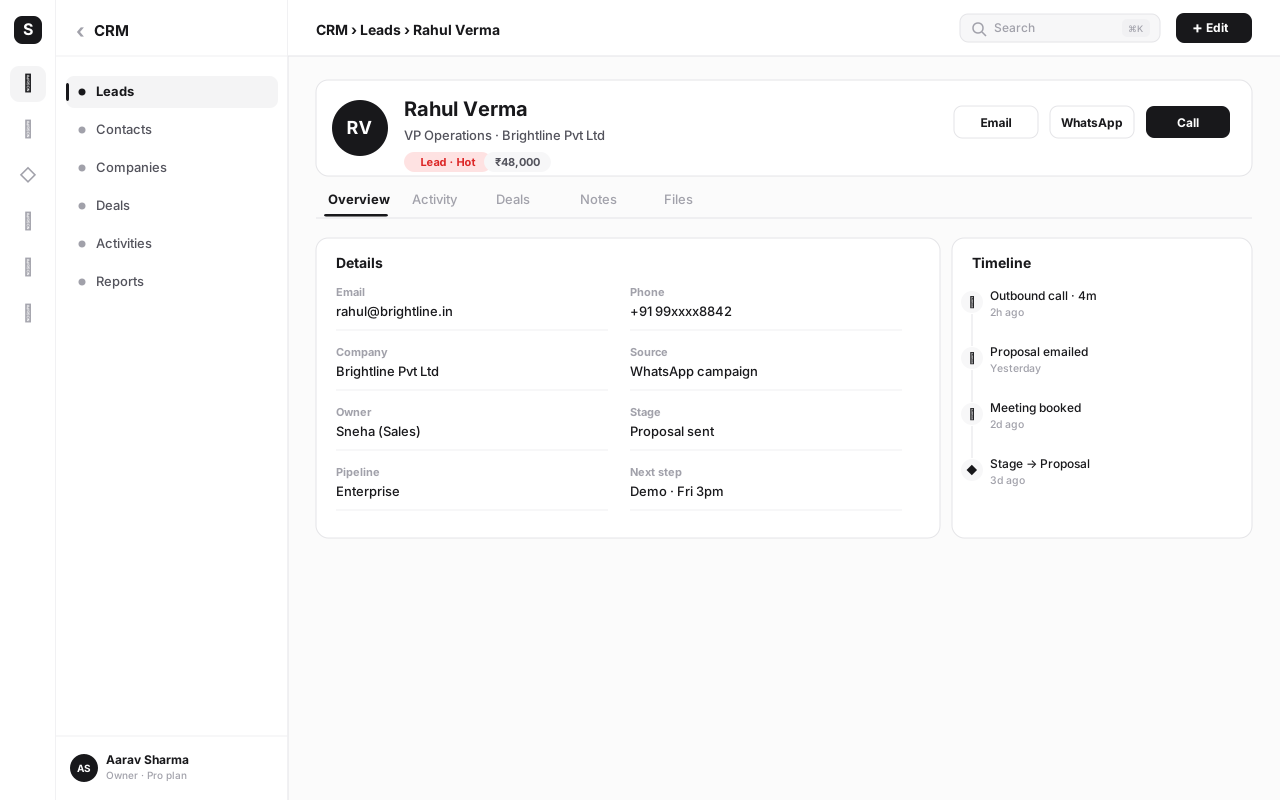
The fix is structural, not a matter of discipline: every WhatsApp conversation, every call note and every site-visit outcome should write to the same CRM contact or deal record automatically, not as a manual copy-paste step someone forgets under pressure. When that's true, any agent — including one covering for a colleague — can open a lead's record and immediately see the full story: the original portal listing, the Flow answers, every message exchanged, which site visits happened and what feedback came out of them, and where the deal currently sits in the pipeline.
| Without CRM-logged WhatsApp | With CRM-logged WhatsApp |
|---|---|
| Lead history lives in one agent's personal phone | Full conversation and requirement history on one shared record |
| A covering colleague starts from zero on handoff | Any agent can pick up mid-conversation with full context |
| No reliable record of what was promised or shown | Every listing shared and every Flow answer is on the timeline |
| Reporting on source and conversion is guesswork | Every lead carries its source, so conversion-by-channel is a real report |
| Departing agents take the relationship history with them | The relationship history stays with the business |
This is also where the platform choice compounds: if WhatsApp, calling and the CRM are three separate tools stitched together with exports and manual entry, the "one shared record" promise breaks the first time someone is busy. When they're natively unified — the same login sees the WhatsApp thread, the call log, the site-visit calendar and the deal stage — there's no syncing step to skip.
How to set up WhatsApp for a real estate lead pipeline#
-
Get WhatsApp Business API access under one number per brokerage or team. Consolidate onto a shared business number rather than individual agents' personal numbers, so conversations survive staff changes and can be worked from a shared inbox.
-
Connect your lead sources. Wire up portal enquiry webhooks, your website's contact form, and click-to-WhatsApp ad campaigns so every new lead lands in the same place — ideally the CRM — the moment it's created.
-
Set up an instant first-response template. Write a short, approved template that acknowledges the enquiry and references the specific listing, so it can fire within seconds of a new lead arriving, before a human has necessarily seen it.
-
Build a requirement-capture Flow. Create one WhatsApp Flow that asks budget, locality, configuration and timeline in a single guided form, ending in a site-visit slot picker tied to your team's calendar.
-
Load your catalog and brochures. Upload current listings with photos, and prepare floor plans and brochures as document-header templates so agents can share them in a tap rather than hunting for files mid-conversation.
-
Assign and route leads to agents automatically. Set rules so a new WhatsApp lead is assigned by locality, project or round-robin the moment it's qualified, landing in the right agent's shared-inbox view instead of a general queue nobody owns.
-
Log every conversation to the CRM by default. Make sure WhatsApp, call and site-visit notes all write to the same contact/deal record with no manual step, so any agent can see full context instantly.
-
Build opt-in nurture segments for your warm database. Tag existing enquirers by budget and locality with clear consent captured, and only broadcast genuinely relevant new listings to those segments — never to a purchased or unconsented list.
-
Review response time and conversion by source weekly. Track how fast the first WhatsApp reply goes out and which lead source converts best, and use that to fix the slowest link first — usually the gap between a lead arriving and a human seeing it.
Put your real estate leads on one WhatsApp-to-CRM pipeline
WaChat gives you the WhatsApp Business API, Flows for requirement capture, catalog sharing and a shared team inbox — natively logged to SabCRM on one login. Start free and connect your first portal lead source today.
Common mistakes#
- Slow first response. Letting a portal lead sit for even thirty minutes before any acknowledgement is often the difference between winning and losing that buyer's attention — automate the first WhatsApp reply so it doesn't depend on someone checking a queue.
- Unsolicited broadcast spam. Sending new-listing broadcasts to a purchased list or anyone who hasn't clearly opted in invites both WhatsApp policy action against your number and real reputational damage in a market where real-estate WhatsApp spam is already a well-known complaint.
- No CRM logging of conversations. Letting agents run leads entirely from their personal WhatsApp app means the business loses the entire relationship history the moment that agent is unavailable or leaves.
- Generic, un-personalized listing blasts. Sending the same message to your whole database regardless of stated budget or locality reads as spam even to genuinely opted-in contacts — segment by what the buyer actually told you.
- Treating WhatsApp as the whole pipeline. Using WhatsApp for the entire journey and skipping a real site visit or a proper negotiation call under-serves a decision this size — WhatsApp should accelerate the early stages, not replace human closing conversations.
- No site-visit follow-up loop. Booking a visit through a Flow and then not capturing what happened afterward wastes the structured data you already collected — log the outcome back onto the same record.
Conclusion#
Real estate has always been a speed-and-trust business — the agent who replies first, with the right information, in the channel the buyer is already comfortable in, tends to win the lead. WhatsApp fits that reality better than almost any other channel available to an Indian brokerage today: instant acknowledgement on portal and ad leads, a structured Flow that captures requirements without a slow back-and-forth, rich media for sharing listings and virtual tours, and — when it's genuinely opted in — a nurture channel for the buyers who aren't ready yet.
None of that works in isolation, though. The real gain comes from tying WhatsApp to the same lead management system that handles calls, site visits and pipeline stages, so any agent can open a lead and see its complete story instead of relying on memory or a personal phone's chat history. That's what turns a fast first reply into a fast, well-informed, and well-tracked deal.
If you're currently running WhatsApp for property leads out of a personal number with no CRM behind it, the fastest fix is connecting your lead sources to a shared WhatsApp Business API number with Flows and CRM logging switched on from day one — start with the pricing that fits your team size and grow into automation as your pipeline scales.
Frequently asked questions
How does WhatsApp help real estate agents respond to leads faster?
A portal enquiry or a click-to-WhatsApp ad opens a live chat the moment a buyer expresses interest, instead of routing them through a call queue or a contact-form email that sits in an inbox. Because WhatsApp is already open on almost every Indian buyer's phone, an agent (or an automated first-reply) can acknowledge the lead within seconds and start qualifying while the buyer's interest is still hot — which is the single biggest lever in real estate conversion.
Can WhatsApp replace a phone call for real estate follow-up?
It doesn't need to replace calls entirely, but for the first response and for structured information-gathering, WhatsApp is often faster and less intrusive than a cold call. Many buyers browsing listings after work hours would rather read and reply to a message than take a call. The best setups use WhatsApp for instant acknowledgement, requirement capture and listing shares, and reserve calls for negotiation and closing conversations.
What is a WhatsApp Flow and how is it used in real estate?
A WhatsApp Flow is a structured, native form that opens inside the chat window — no redirect to an external site. In real estate, a Flow can capture budget range, preferred locality, configuration (1BHK/2BHK/3BHK), and move-in timeline in one guided sequence, and can end with a site-visit slot picker. It replaces a slow back-and-forth of typed questions with a form that takes under a minute to fill and returns clean, structured data to the agent's CRM record.
Is it legal to send WhatsApp broadcasts to a real estate buyer database?
You can only message a template category and receive a broadcast if the recipient has opted in and the 24-hour service window rules are respected, or you use an approved marketing template. Real estate is a category with a well-known spam complaint history, so broadcasting new listings to a purchased or scraped number list is both against WhatsApp's commerce policy and likely to get your number restricted. Only message people who gave your business genuine consent, and make opting out trivially easy.
How do click-to-WhatsApp property ads work?
A click-to-WhatsApp ad on Facebook or Instagram shows a property listing and, instead of sending the viewer to a landing page with a lead form, opens a WhatsApp conversation directly with the agent or the brokerage's WhatsApp Business number. The buyer is already typing within a few taps, which tends to produce more replies than a form that asks for a phone number and waits for a callback.
Can one agent handle many active leads on WhatsApp without losing track?
Yes, provided every conversation is logged against a CRM contact or deal record rather than living only inside a phone's chat app. With a shared team inbox and CRM-linked WhatsApp, an agent (or a colleague covering for them) can open any lead and see every message, call note and site-visit outcome in one timeline, instead of relying on memory or scrolling through a personal WhatsApp history.
What's the difference between using a personal WhatsApp number and the WhatsApp Business API for a real estate brokerage?
A personal number or the free WhatsApp Business App works for a single agent handling a handful of leads, but it has no team inbox, no automation, no broadcast tooling, and no CRM link — everything lives in one person's phone. The WhatsApp Business API, accessed through a provider like SabNode, adds a shared inbox multiple agents can work from, Flows, template broadcasts, catalog sharing and native CRM logging, which is what a brokerage handling dozens of live leads actually needs.