Best WhatsApp Business API Providers in India (2026 Comparison)
There's no single 'best' WhatsApp API provider — there's the best one for what you're actually trying to do. Here's a fair, honest look at the leading options in India.
There's no single "best" WhatsApp Business API provider in India — there's the best one for what you're actually trying to do. A solo founder running broadcast campaigns on a budget, a real estate sales team blasting leads all day, a Shopify store automating order updates, a developer team building custom messaging infrastructure, and a business that wants WhatsApp bundled with its CRM and calling all have genuinely different "best" answers. This guide compares the leading providers — Wati, AiSensy, Gupshup, Interakt, DoubleTick, Gallabox, 360dialog, Twilio, respond.io, and SabNode's WaChat — fairly, by who each one is actually built for, so you can match the tool to your job instead of chasing a universal winner.
Why "best" depends on the buyer#
WhatsApp Business API isn't one product — it's a Meta-owned messaging layer (officially the WhatsApp Business Platform / Cloud API) that dozens of companies build a business on top of, each shaping the same underlying capability into a different kind of product. Understanding the shape of that market makes the individual comparisons below much easier to read.
Broadly, providers split along a few axes:
- No-code vs. developer-first. Some providers (Wati, AiSensy, Interakt, DoubleTick, Gallabox, WaChat) hand you a dashboard, a broadcast composer and a drag-and-drop chatbot builder so a non-technical team can run WhatsApp messaging on day one. Others (360dialog, Gupshup's core API products, Twilio) are closer to raw infrastructure — you or a developer typically build the interface and logic on top of their API.
- WhatsApp-only vs. multi-channel. Most providers in this list are WhatsApp-first, even if some also touch SMS or other channels. Twilio and respond.io are explicitly multi-channel by design — WhatsApp is one channel among several rather than the whole product.
- India-focused vs. global. Wati, AiSensy, Gupshup, Interakt, DoubleTick and Gallabox are all India-founded and built with Indian SMB pricing, support hours and use cases (Shopify sellers, real-estate sales floors, kirana-adjacent D2C brands) in mind. 360dialog (Germany), Twilio (US) and respond.io (Singapore) are global platforms used heavily in India but not built around it exclusively.
- Pure WhatsApp tool vs. bundled platform. Nearly every provider here treats the WhatsApp conversation as the central object. SabNode's WaChat is the one entry in this list built the other way around — the contact record is central, and WhatsApp is one of several connected channels (alongside calling, SMS, email and CRM) attached to that same record.
None of these axes make a provider objectively better or worse — they just describe a different bet about what you need from a WhatsApp tool. Grouped into rough categories, the market looks like this:
| Category | Providers | Typical buyer |
|---|---|---|
| No-code, general-purpose WhatsApp platforms | Wati, AiSensy, Gallabox | SMB/mid-market teams wanting broadcast + chatbot + inbox without developers |
| WhatsApp-first with a specialty angle | Interakt (e-commerce), DoubleTick (sales-outbound) | Teams with one dominant use case the specialist is tuned for |
| Infrastructure / API-first | 360dialog, Gupshup's core API products | Developer teams and larger technical orgs building their own UI |
| Global multi-channel CPaaS / omnichannel | Twilio, respond.io | Engineering-led or multi-channel teams needing more than WhatsApp alone |
| Bundled CRM + WhatsApp platform | SabNode (WaChat) | Businesses wanting WhatsApp, CRM, calling, SMS, email and payments on one login |
The sections below go provider by provider, followed by a full side-by-side table.
One cost structure is common to every provider in this comparison and worth understanding before you look at a single vendor's pricing page: Meta itself charges per conversation (billed by category and country, and identical no matter which company you route your API access through), and every provider then adds its own software or platform fee on top of that. A "cheap" provider and an "expensive" provider are really only competing on the second layer — the software fee — not on Meta's own charges, which is one reason price-per-message comparisons across vendors can be misleading if you don't separate the two.
Wati#
Wati is one of the most recognizable names in India's WhatsApp Business API space — an India-founded platform with a broad, mature feature set: broadcast campaigns, a visual chatbot/flow builder, a product catalog, and a shared team inbox for support and sales conversations. Its ecosystem is a particular strength: a wide library of native integrations plus Zapier and Make connectors, which makes it a common pick for teams that already run a stack of other tools and want WhatsApp to plug into it rather than replace it. Wati is generally considered a strong, general-purpose choice for teams that want automation depth without hiring developers — confirm current pricing and exact plan inclusions on wati.io, since tiers shift over time.
AiSensy#
AiSensy has built its India reputation around affordable, clearly tiered pricing aimed squarely at small and mid-sized businesses — broadcast campaigns, basic chatbot/automation flows, and a live chat inbox cover most of what an SMB needs from WhatsApp without a steep learning curve. It's a common first WhatsApp API tool for businesses that want to get broadcasting quickly at a lower entry cost than some of the more feature-dense platforms. As with every provider here, confirm AiSensy's current tiers directly on their site, since affordable-tier pricing is exactly the kind of detail that shifts as a company scales its offering.
Gupshup#
Gupshup is one of the longest-established messaging/CPaaS companies in India, predating the WhatsApp Business API itself by years as an SMS and multi-channel messaging platform. That history shows in its positioning: Gupshup is a broad, multi-channel platform (SMS, RCS, voice and more, not just WhatsApp) with deep telecom and enterprise relationships, and its core products have historically leaned more API/platform-first than small-business-dashboard-friendly. Larger enterprises and telecom-adjacent businesses often find Gupshup's scale and relationships valuable; smaller teams wanting a simple point-and-click WhatsApp dashboard may find some of Gupshup's product surface built more for technical buyers. Gupshup has also expanded into more no-code-friendly offerings over time, so check their current product lineup rather than assuming it's purely an API play today.
Interakt#
Interakt is an India-founded, WhatsApp-first platform with a distinctive angle: strong e-commerce integration, particularly with Shopify, alongside chatbot/automation tooling and CRM-lite features (basic contact and order context attached to conversations). That makes it a frequent pick for D2C and e-commerce sellers who want WhatsApp order confirmations, abandoned-cart nudges and support conversations tied to their store data without custom development. Outside e-commerce, Interakt covers similar broadcast-and-automation ground to other India-focused providers in this list — confirm current feature depth and pricing on their site if e-commerce isn't your primary use case.
DoubleTick#
DoubleTick, by Telecrm, is an India-focused provider built specifically around bulk broadcast and agent-based sales workflows — think real-estate brokers, education counselors, loan agents and D2C phone-sales teams where each salesperson needs to message a lead list fast and be clearly identifiable as "their" contact. Its per-agent number/conversation assignment model and mobile-first app experience are tuned for that one persona rather than for general customer support or e-commerce automation. If your team's entire WhatsApp job is "broadcast to a list, then have an individual rep follow up," DoubleTick's focus is a real strength rather than a limitation — see our fuller DoubleTick vs Wati comparison for more detail on that specific matchup.
Gallabox#
Gallabox is another India-founded WhatsApp Business API platform, positioned with a broad automation/chatbot builder, live chat inbox and a set of integrations, generally aiming at SMB-to-mid-market teams that want no-code chatbot flows alongside standard broadcast and shared-inbox functionality. It sits in similar territory to Wati and AiSensy — general-purpose India WhatsApp tooling rather than a narrow specialist — so the deciding factor between the three for a given business is often specific integration needs, UI preference, and current pricing rather than a fundamental difference in capability. Teams comparing all three often find the actual chatbot-builder mechanics (how branching, variables and human hand-off are configured) matter more day to day than any single headline feature, which is why a hands-on trial tends to be more decisive than a spec-sheet comparison. Confirm Gallabox's current feature set and tiers directly on their site.
360dialog#
360dialog, founded in Germany, was one of Meta's original official Business Solution Partners globally and has a long-standing reputation as an infrastructure/API-first WhatsApp provider — many businesses use 360dialog specifically to get official API access and then build their own front-end UI, chatbot logic and CRM integration on top, rather than using a ready-made dashboard. That makes it a strong fit for developer teams and larger technical organizations who want full control over the conversational experience and don't want to be boxed into a vendor's own UI. For a business without in-house development capacity, 360dialog's API-first model generally means more setup work than a no-code platform, so it's worth weighing that against the control it offers. Its long history as an early, official Meta partner also means it's a familiar name to agencies and system integrators who build WhatsApp solutions for multiple end clients rather than for a single in-house team.
Twilio#
Twilio is a large, global Communications Platform as a Service (CPaaS) — WhatsApp is one channel among SMS, voice, email and more inside a single, deeply developer-first API platform used by companies building fully custom messaging infrastructure. Twilio makes sense for teams (often engineering-led) that want to build a bespoke messaging product or workflow spanning multiple channels with one underlying API, rather than adopt any single channel's off-the-shelf dashboard. It's less commonly the first choice for a small business wanting a quick, no-code WhatsApp broadcast tool, and more commonly chosen by product and engineering teams building something Twilio's API can be a foundation for. Because Twilio's business spans far beyond WhatsApp, it's also a common choice for organizations that want one vendor relationship and one API pattern across every messaging channel they touch, rather than a separate contract per channel.
respond.io#
respond.io is an omnichannel customer conversation platform — WhatsApp plus a range of other channels (Messenger, Instagram, SMS, web chat, and more) unified into one inbox, with strong automation and broadcast features layered on top. Its positioning is closer to "business messaging operating system" than "WhatsApp tool," which suits teams whose customers reach them across several channels and who want one workflow and one set of automation rules spanning all of them, rather than a WhatsApp-specific dashboard. For a business whose customer contact is overwhelmingly WhatsApp-only, respond.io's broader channel coverage may be more platform than is strictly needed; for a business genuinely fielding conversations across several channels, that same breadth is the point. Marketing, e-commerce and support teams juggling WhatsApp alongside Instagram DMs and web chat are a common respond.io fit, since consolidating routing and automation rules across channels in one place removes the need to replicate the same logic separately in each channel's own tool.
SabNode / WaChat#
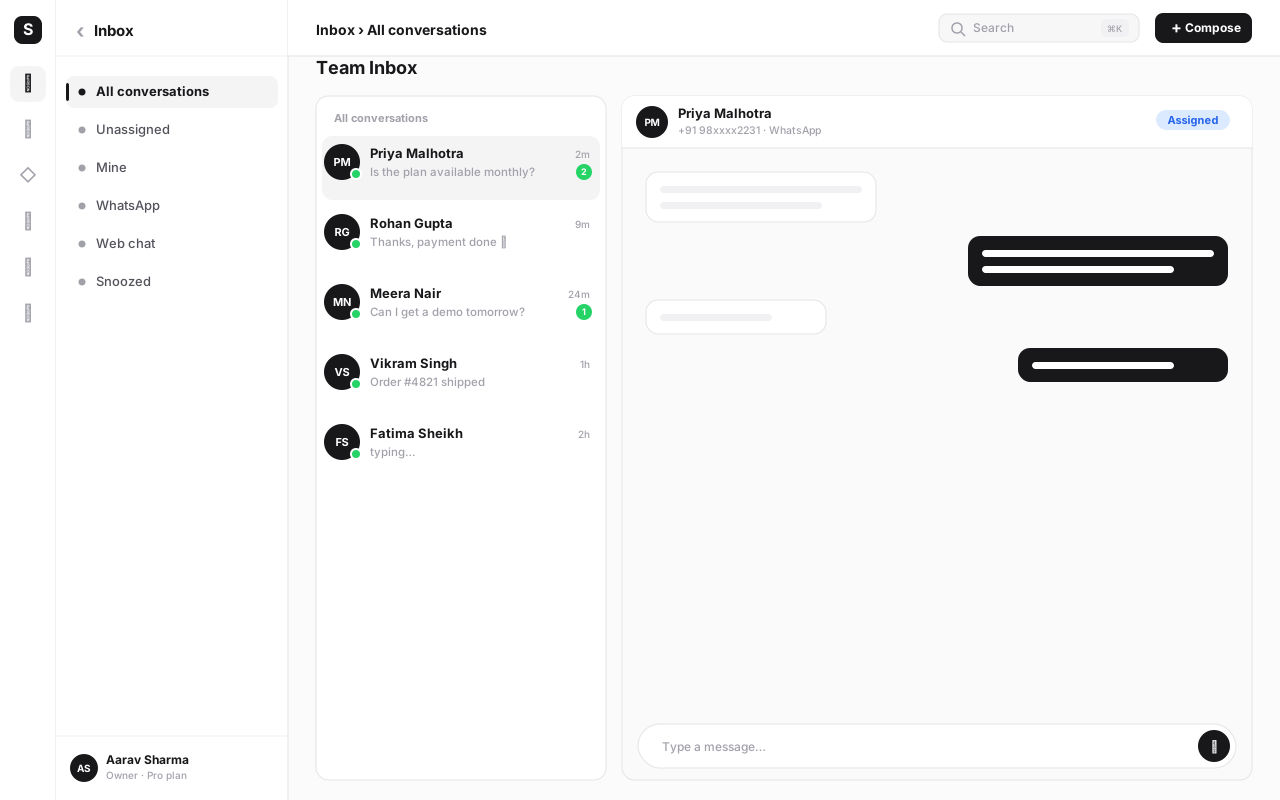
SabNode's WaChat module covers the same core WhatsApp Business Platform (Cloud API) ground as the providers above — broadcast campaigns, a chatbot/flow builder, a product catalog, a shared team inbox, WhatsApp Flows, and click-to-WhatsApp ad support. Its differentiator isn't claiming to out-feature any single WhatsApp specialist on WhatsApp alone; it's that WaChat is natively unified with a full CRM, cloud calling, SMS, email, workflow automation and payments on one login and one bill, so a WhatsApp conversation, a phone call and an email to the same customer all update the same contact record without a separate integration or connector. That structural bet matters most to businesses that already know (or expect) they'll need more than WhatsApp — a pipeline to track leads in, a dialer for follow-up calls, an SMS channel for customers without reliable data. For a business whose entire need really is WhatsApp and nothing else, a WhatsApp specialist from elsewhere on this list may be the simpler pick.
SabNode's pricing is published and transparent rather than quote-only: Starter is free forever (2 users, 1,000 contacts, 500 messages/month); Growth is ₹2,499/month or ₹24,990/year (10 users, 50,000 contacts, all modules included); Scale is ₹9,990/month or ₹99,900/year; and Enterprise is custom-priced for larger teams. Signup is free with no card required at sabnode.com/signup.
See WhatsApp bundled with CRM, calling, SMS and payments on one login
WaChat covers the same core WhatsApp ground as the specialists above — broadcast, chatbot builder, shared inbox, catalog, Flows — natively connected to CRM, calling, SMS, email and payments. Start free on sabnode.com, no credit card required.
This isn't a ranked "#1 to #10" list — it's a map of what each provider is actually built for. Wati, AiSensy, Interakt, DoubleTick and Gallabox are all legitimate, India-built WhatsApp tools with real customers; Gupshup and 360dialog are established infrastructure players; Twilio and respond.io serve broader messaging needs; and SabNode is a different kind of bet entirely — WhatsApp as one connected piece of a bigger platform. The "best" one is whichever matches your actual workflow.
All ~10 providers at a glance#
| Provider | Best for | Notable strength | Pricing model (hedge: confirm current) |
|---|---|---|---|
| Wati | General-purpose SMB/mid-market WhatsApp with automation depth | Deep chatbot/flow builder, wide integration ecosystem (native + Zapier/Make) | Tiered by features/volume — confirm on wati.io |
| AiSensy | Budget-conscious India SMBs wanting quick broadcast setup | Affordable, clearly tiered pricing; strong India SMB adoption | Tiered, entry-friendly — confirm on aisensy.com |
| Gupshup | Enterprises/telecoms wanting a multi-channel messaging platform | Long-established CPaaS scale, multi-channel (SMS/RCS/voice), enterprise relationships | Platform/API-first, enterprise-leaning — confirm on gupshup.io |
| Interakt | E-commerce sellers, especially on Shopify | Strong Shopify/e-commerce integration, CRM-lite context on conversations | Tiered by volume/features — confirm on interakt.shop |
| DoubleTick | SMB sales teams doing high-volume outbound WhatsApp | Per-agent number/conversation assignment, mobile-first app | Historically per-agent/per-number tiers — confirm on doubletick.io |
| Gallabox | SMB-to-mid-market teams wanting no-code chatbot + inbox | Broad automation/chatbot builder, live chat, integrations | Tiered by features/volume — confirm on gallabox.com |
| 360dialog | Developer teams and larger technical orgs building custom UI | Original official Meta BSP, infrastructure/API-first control | API-usage-based, developer-oriented — confirm on 360dialog.com |
| Twilio | Engineering-led teams building fully custom multi-channel messaging | Global CPaaS scale; WhatsApp as one channel among SMS/voice/email | Usage-based, per-channel — confirm on twilio.com |
| respond.io | Teams fielding conversations across many channels, not just WhatsApp | True omnichannel inbox with strong automation/broadcast | Tiered by contacts/features — confirm on respond.io |
| SabNode (WaChat) | Businesses wanting WhatsApp bundled with CRM, calling, SMS, email, payments | Full WhatsApp feature set natively unified with a whole business platform | Published: free Starter; ₹2,499/mo Growth; ₹9,990/mo Scale; custom Enterprise |
How to evaluate a WhatsApp API provider for your business#
- Map your actual daily workflow before looking at any vendor. Write down what your team literally does with WhatsApp all day — broadcasting to a list, running a shared support inbox, automating order updates, or building something fully custom. The workflow, not a feature checklist, should drive which category of provider (no-code SMB tool, sales-outbound tool, infrastructure/API platform, omnichannel platform, or bundled CRM+WhatsApp platform) you even start evaluating.
- Check whether you need WhatsApp-only or multiple channels. If your customers only ever reach you on WhatsApp, a WhatsApp-first tool is simpler. If they also call, email, or message you on other channels, weigh a multi-channel option (respond.io, Twilio, or a bundled platform like SabNode) against juggling separate tools per channel.
- Be honest about your team's technical capacity. No-code platforms (Wati, AiSensy, Interakt, DoubleTick, Gallabox, WaChat) get you running without developer time; infrastructure-first providers (360dialog, Gupshup's core API, Twilio) generally assume you'll build a UI and logic layer, which means budgeting real developer hours.
- Test the chatbot/automation builder with a real flow, not a demo. If automation depth matters to your decision, build one actual flow — a simple FAQ triage or order-status lookup — in each finalist's trial account rather than trusting a sales demo video.
- List every other tool WhatsApp needs to talk to. CRM, helpdesk, e-commerce platform, calling tool, SMS gateway — write the list, then check each candidate's integration catalog (or native module coverage, in a bundled platform) against it specifically.
- Check Meta's messaging-tier limits against your real volume. Meta's own 24-hour conversation limits (250 / 1K / 10K / 100K / unlimited, tied to your number's quality rating) apply no matter which provider you pick — no vendor can send faster than Meta allows for your specific number.
- Get current pricing in writing for your real usage. Ask each vendor to quote your actual user count, contact volume and required features, then add Meta's separate conversation charges to get the true monthly cost — not just the advertised entry-tier price.
- Run a genuine trial with real, opted-in contacts. A short test with dummy data won't surface the friction (or ease) of your actual workflow — use real contacts for at least two to four weeks before signing an annual contract.
Several providers in this comparison, including SabNode, offer a free-forever entry tier or a free trial. Before committing to any paid plan, run your actual workflow — a real broadcast, a real chatbot flow, a real team inbox handoff — on the free tier of your top two or three finalists. It's the cheapest due-diligence step available and it surfaces friction no comparison article can.
Common mistakes when choosing a WhatsApp API provider#
Picking on price-per-message alone. The advertised plan price is only one part of total cost — Meta's own conversation charges apply identically regardless of provider, and a cheaper tool missing a feature you actually need often costs more once you add a second subscription or a Zapier/Make bill to compensate.
Assuming "official BSP" or "Meta partner" status is the differentiator. Most established providers in this space operate as, or on top of, a Meta Business Solution Provider — that's the standard route to API access, not a rare advantage one vendor uniquely has. Confirm current partner status if it matters to your procurement process, but don't treat it as a tiebreaker on its own.
Choosing a developer-first platform without developer capacity (or vice versa). Signing up for an infrastructure/API-first provider like 360dialog or Twilio without budgeted developer time to build the UI and logic on top leads to a stalled rollout; conversely, a technical team that needs deep custom control may find a no-code dashboard limiting.
Ignoring what happens once you outgrow WhatsApp-only. Many businesses that start with a WhatsApp-only tool eventually also want a CRM, a dialer and an SMS channel — and only then discover they're evaluating, buying and integrating three or four more subscriptions on top of whichever WhatsApp tool they picked first.
Quoting old pricing or feature limits as current fact. Every provider's tiers, quotas and integration catalogs change over time — treat any specific number in this article, or any other comparison you read, as a snapshot to reconfirm on the vendor's live pricing page, not a permanent fact.
Not testing the chatbot/automation builder before buying. A polished demo video doesn't tell you how much friction there is building your own flow — build one real flow in a trial account before deciding automation depth is (or isn't) sufficient.
Treating multi-channel breadth as automatically better. If your customers genuinely only use WhatsApp, a broader omnichannel platform's extra channels are unused surface area, not value — match breadth to your actual customer contact pattern.
Conclusion#
The Indian WhatsApp Business API market has genuinely different products wearing a similar-looking label. Wati, AiSensy, Interakt, DoubleTick and Gallabox each serve variations of the no-code SMB use case with different specialties (chatbot depth, pricing, e-commerce, sales-outbound, automation). Gupshup and 360dialog serve technical and enterprise buyers who want infrastructure to build on. Twilio and respond.io serve teams that need WhatsApp as one channel inside something bigger. And SabNode's WaChat serves a different bet entirely — the full WhatsApp Business Platform feature set, natively unified with CRM, calling, SMS, email and payments on one login.
None of these is the universally "best" WhatsApp API provider, because "best" only means something once you know what you're optimizing for. Use the evaluation steps and the comparison table above to shortlist two or three providers whose category actually matches your workflow, then run real trials with real contacts before committing to an annual plan.
If your shortlist includes a bundled platform, our WhatsApp Business API complete guide covers the underlying Cloud API fundamentals that apply no matter which provider you choose, and what is SabNode explains how WaChat fits into the rest of the platform if you decide WhatsApp bundled with CRM, calling and SMS is the structural bet you want to make. Whichever direction you go, confirm current pricing and features directly with each vendor — this comparison, like every other, is a starting point, not a substitute for a live trial with your own data.
Frequently asked questions
What is the best WhatsApp Business API provider in India?
There isn't one universal answer — the 'best' provider depends on what you're optimizing for. Wati and Gallabox suit teams that want a broad, general-purpose WhatsApp platform with a strong chatbot builder. AiSensy and Interakt are popular with India SMBs wanting affordable pricing and (for Interakt) deep Shopify/e-commerce ties. DoubleTick suits sales-led teams doing bulk outbound. Gupshup and 360dialog suit developers and larger technical teams who want infrastructure to build on. Twilio suits teams that want WhatsApp as one channel inside a much larger custom messaging stack. respond.io suits teams that want a full omnichannel inbox beyond WhatsApp. And platforms like SabNode's WaChat suit teams that want WhatsApp bundled natively with CRM, calling, SMS, email and payments on one login. Match the tool to the job rather than looking for a universal winner.
Are all of these providers officially approved by Meta/WhatsApp?
Most of the providers in this comparison operate as Meta Business Solution Providers (BSPs) or resell/build on top of one, which is the standard, legitimate route to WhatsApp Business Platform (Cloud API) access for a business — you generally cannot get official API access without going through Meta directly (Meta's own onboarding) or a BSP. Exact partner status and tiering change over time, so if formal BSP status matters to your compliance or procurement process, confirm each vendor's current standing directly on their site or with Meta.
Do I need a developer to set up a WhatsApp Business API integration?
It depends which kind of provider you pick. No-code-leaning platforms (Wati, AiSensy, Interakt, DoubleTick, Gallabox, and SabNode's WaChat) are built so a non-technical team can connect a number, approve templates and run broadcasts without writing code. More infrastructure/API-first providers (360dialog, Gupshup's core API products, Twilio) generally assume you or your team will build a UI and logic layer on top of their API, which usually means you'll want developer time budgeted in. Neither approach is wrong — it's a question of whether you want a ready-made interface or you're building your own.
How much does WhatsApp Business API cost in India?
Cost has two layers that apply regardless of which provider you pick: Meta's own per-conversation charges (billed by conversation category and country, set by Meta, identical no matter which BSP you route through) and the provider's own software/platform fee on top. Provider fees range from free-forever entry tiers to enterprise custom pricing, and change often, so treat any specific number — including the figures mentioned in this article for SabNode — as something to verify on the vendor's current pricing page rather than a fixed fact.
What's the difference between a WhatsApp API tool and a WhatsApp CRM?
A pure WhatsApp API tool (most of the providers here, in their core form) focuses on sending/receiving WhatsApp messages, templates, broadcast and often a chatbot builder, with the conversation itself as the main object. A WhatsApp CRM — or a platform like SabNode that bundles WhatsApp into a broader CRM — treats the contact as the main object, with WhatsApp as one of several channels (alongside calls, SMS, email) attached to that same contact record. If you mainly need to send and manage WhatsApp messages, a WhatsApp-first tool is simpler. If you need WhatsApp conversations to update the same pipeline, deal and contact history that your calling and email already touch, a bundled CRM-plus-WhatsApp platform removes a sync step.
Can I switch WhatsApp API providers without losing my number or message history?
Your WhatsApp Business Account (WABA) and phone number are tied to Meta, not to whichever BSP currently manages API access for it, so switching providers is a standard re-verification process rather than starting over with a new number. You'll typically need to re-submit your approved message templates and export/import your contacts on the new platform, but the number itself and its verification status carry over. Historical conversation data stored inside your old provider's dashboard, however, usually does not migrate automatically — export it before you switch if you need it.
Is a cheaper WhatsApp API provider always the better choice?
Not necessarily. The sticker price of the software is only one line of the real cost — Meta's per-conversation charges apply identically no matter which provider you choose, and a cheaper tool that lacks a feature you need (a chatbot builder, a CRM sync, enough team seats) can cost more in the end via a second subscription, a Zapier/Make bill, or lost time reconciling data across tools. Evaluate total cost for your actual workflow, not just the lowest monthly plan price.