WhatsApp Marketing vs SMS Marketing: Which Wins?
WhatsApp and SMS solve different jobs. SMS gives near-universal, app-free reach for OTPs and critical alerts; WhatsApp adds rich, two-way conversational marketing. Here's a fair, India-first breakdown of which channel wins for which message — and why the smartest answer is both.
WhatsApp marketing and SMS marketing aren't rivals so much as specialists. SMS wins on raw reach — it lands on every phone with no app, no internet and no opt-in for transactional sends — which makes it unbeatable for OTPs and critical alerts. WhatsApp wins on rich, two-way conversation. For most Indian businesses, the right answer is both.
That nuance gets lost in most "X vs Y" debates, where one channel is crowned and the other dismissed. The reality for an Indian SMB or growing brand is more practical: you have OTPs to deliver, sale announcements to send, support queries to answer and abandoned carts to recover — and those messages don't all want the same channel. This guide compares WhatsApp marketing (run through SabNode WaChat) and SMS marketing (run through SabNode SabSMS) fairly, dimension by dimension, then gives you a clear decision framework for which to use when. By the end you'll know not which channel "wins," but which message belongs on which.
The short answer: different jobs, not a single winner#
If you came here for a one-word verdict, here it is: it depends on the message. That isn't a dodge — it's the whole point. A one-time password and a Diwali sale announcement have almost nothing in common as communication tasks, and forcing both down the same pipe is how businesses end up either annoying customers or failing to reach them.
SMS is a broadcast utility. It's the dial tone of business messaging in India: every handset can receive it, it needs no app installed and no data connection, and for transactional content it reaches numbers regardless of opt-in status. That universality is exactly why banks send OTPs over SMS and why a delivery alert still arrives on a feature phone in a low-signal area.
WhatsApp is a conversation platform. It assumes the recipient has the app and has opted in, and in return it gives you formatting, images, video, documents, interactive buttons, list menus, product catalogs and a genuine back-and-forth thread. It's not a louder megaphone; it's a different medium — closer to a chat with a shop assistant than a one-way notice.
Hold that framing through everything below. The dimensions that follow — reach, media, cost, compliance, engagement, conversation — each tilt one way or the other, and the winner flips depending on what you're trying to send.
Head-to-head: WhatsApp vs SMS at a glance#
Here is the full comparison across the dimensions that actually decide channel choice. Read it as "which tool fits this job," not as a scorecard where the channel with more ticks wins.
| Criteria | WhatsApp marketing (WaChat) | SMS marketing (SabSMS) |
|---|---|---|
| Reach / addressable audience | Needs the app installed + opt-in | Near-universal — any phone, any network |
| Internet required to receive | Yes — data or Wi-Fi | No — works fully offline |
| Opt-in for transactional messages | Required (documented opt-in) | Not required for transactional / OTP |
| Rich media (image, video, doc) | Yes — native | No — plain text only |
| Interactivity (buttons, lists, catalog) | Yes — quick replies, CTAs, list menus, catalog | No — text + a link at most |
| Two-way conversation | Yes — full threaded chat | Limited — needs a separate long/short code |
| Message length | Long-form, formatted | ~160 characters per segment |
| Cost model | Per 24-hour conversation, by category | Per message segment |
| India compliance regime | Meta-approved templates + opt-in | DLT registration + approved templates |
| Delivery speed for OTP / critical alerts | Fast, but app/internet-dependent | Instant, app-independent — the gold standard |
| Best-fit use case | Conversational marketing, support, catalog | OTP, authentication, critical service alerts |
There's no row where one channel is simply "wrong." SMS losing on rich media isn't a flaw — it's the reason it works on every phone with no app. WhatsApp needing opt-in isn't a weakness — it's what makes the channel feel personal rather than spammy. Each strength has a matching trade-off.
Reach and deliverability: SMS's home turf#
If the only thing that mattered were "will this message physically arrive on the device," SMS would win every time. It is the most universally addressable channel in India by a wide margin. There is no app to install, no account to create, no internet connection required, and no algorithm deciding whether your message is shown. A handset that can do nothing else can still receive an SMS.
That matters more in India than in markets with near-total smartphone penetration. Your audience includes feature phones, budget Android devices with spotty data, rural areas with weak signal, and customers who simply haven't installed WhatsApp. For a payment confirmation or a one-time password, you cannot afford for the message to silently fail because someone was offline — and with SMS, it won't.
SMS also reaches numbers on DND (Do Not Disturb) registries for transactional and service content. A delivery alert, an OTP or an appointment reminder is a legitimate service message that lands regardless of a customer's promotional preferences. That's a deliverability guarantee WhatsApp's opt-in model deliberately doesn't make.
WhatsApp's reach is large and growing — it's among the most-used apps in India — but it is conditional. The recipient must have the app, be online, and have opted in to hear from you. When all three are true, WhatsApp delivery is excellent. When they aren't, the message waits or fails. So for the specific job of guaranteed, immediate delivery to anyone, SMS is the stronger channel, and it's not particularly close.
Rich media and interactivity: WhatsApp's home turf#
Now flip the lens. The moment a message wants to do more than state a fact, WhatsApp pulls decisively ahead — because SMS is, by design, plain text in roughly 160 characters. You can include a link, but you cannot show a product image, attach a PDF invoice, offer tappable reply buttons or present a menu of choices.
WhatsApp carries all of that natively. A single WhatsApp message can include a product photo, a formatted caption, quick-reply buttons ("Track order" / "Talk to support"), call-to-action buttons that open a link or dial a number, and list messages that present a tidy menu of options. Go further and you can attach a product catalog, letting customers browse items and add to cart inside the chat. None of this is possible over SMS.
The difference isn't cosmetic — it changes what the message can accomplish. An SMS can tell a customer their cart is waiting; a WhatsApp can show the exact product, restate the price, and give a one-tap "Complete purchase" button. An SMS can say "your order shipped"; a WhatsApp can show the item, attach the invoice and offer a "Track" button that returns live status. Interactivity collapses multi-step journeys into a single tap.
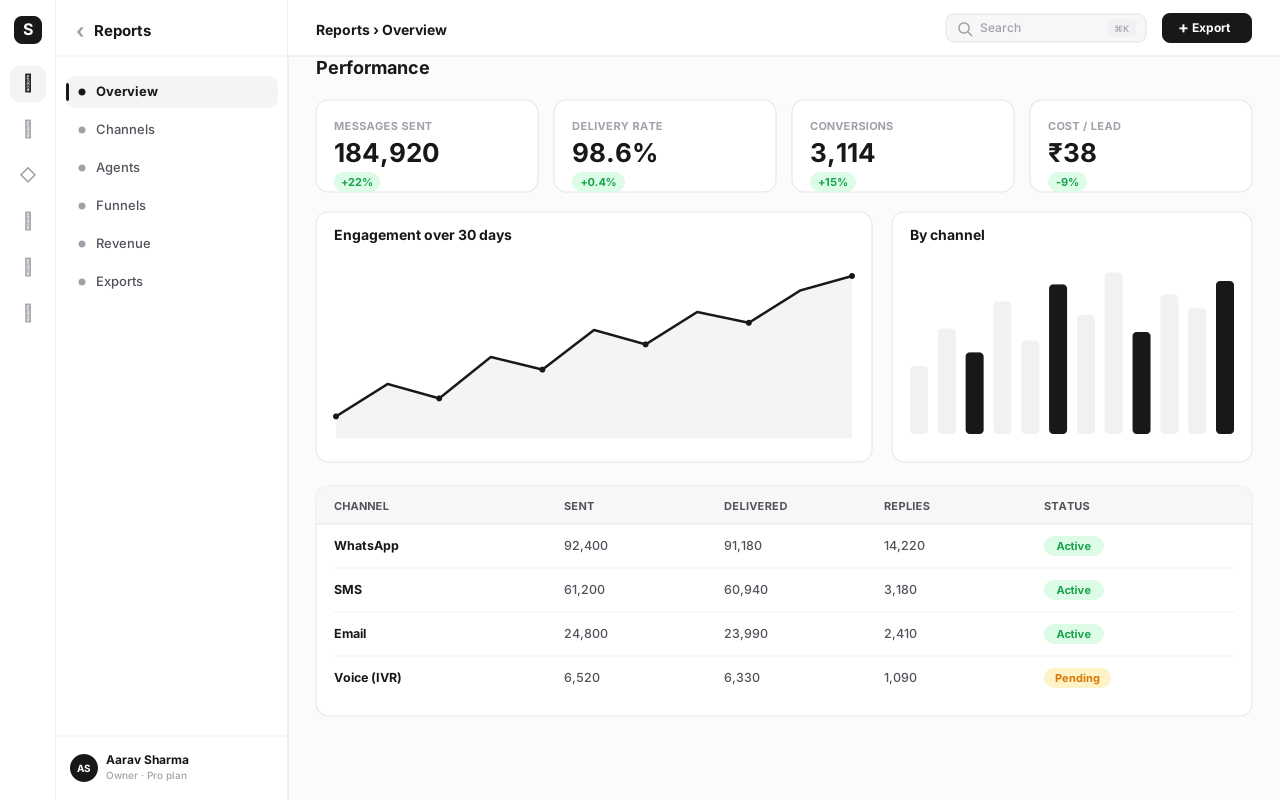
This is also where WhatsApp's engagement edge comes from. Rich, relevant, tappable messages invite a response in a way a wall of text doesn't. For conversational marketing, support and anything involving a product, WhatsApp's media and interactivity make it the obvious choice — a depth we cover fully in the WhatsApp Business API guide.
Cost model: per-conversation vs per-segment#
Cost comparisons between these two channels go wrong when people compare a single per-unit price. The channels are billed on fundamentally different units, so "which is cheaper" genuinely depends on the message.
SMS is billed per segment. A segment is roughly 160 characters in standard GSM-7 encoding (about 70 if you include emoji or other Unicode, which flips the whole message to a smaller budget). A short OTP is one cheap segment. A long promotional message might be two or three segments, each billed. The model is simple and predictable: more characters, more sends, more cost.
WhatsApp is billed per 24-hour conversation, by category. Open a conversation with a customer and you're charged once for that 24-hour window regardless of how many messages flow back and forth inside it. Crucially, the rate depends on the category:
| WhatsApp conversation category | What it covers | Relative cost |
|---|---|---|
| Authentication | OTPs and verification codes | Low |
| Utility | Order updates, alerts tied to a transaction | Low to moderate |
| Marketing | Promotions, offers, re-engagement | Highest |
| Service | Replies to customer-initiated chats | Often free within the 24-hour window |
The practical upshot: for a one-shot OTP, SMS is usually the cheaper, simpler choice. For an ongoing exchange — a support thread, a back-and-forth about an order, a conversation that would have taken five SMS — WhatsApp's single conversation charge often costs less per outcome, and delivers a far better experience. And service replies to a customer who messaged you first are frequently free, which makes WhatsApp inbound support remarkably cheap to run.
Don't pick a channel on the headline per-unit price. Map your real message types — how many OTPs, how many promotions, how many support threads — and price each on the right channel. Most businesses find OTPs are cheapest on SMS while conversations are cheapest on WhatsApp, which is exactly why running both on one platform beats forcing everything onto one.
Compliance: two completely separate regimes#
Both channels are well-regulated in India, but by entirely different systems. Satisfying one does not satisfy the other, and treating them as interchangeable is a fast route to blocked messages.
SMS runs on DLT. India's Distributed Ledger Technology framework requires you to register your business as a principal entity on a DLT portal, register your sender IDs (numeric headers for promotional, alphanumeric like SABNOD for transactional), and register every content template before you can send it. Promotional SMS is further constrained by a daytime sending window and DND scrubbing. It's structured and a little bureaucratic, but once set up it's stable and predictable — the full process is in our DLT registration guide.
WhatsApp runs on Meta's rules. There's no DLT involvement. Instead you need a verified WhatsApp Business Account, documented opt-in from every contact, and Meta-approved message templates to start any conversation outside the 24-hour service window. Meta assigns your number a quality rating and a messaging limit tier; blocks and "report" taps lower the rating and can cap or pause your sending. The discipline is different — relevance and consent rather than DLT paperwork — but it's just as real.
| Compliance element | SMS (DLT regime) | WhatsApp (Meta regime) |
|---|---|---|
| Governing body | Telecom regulator via DLT operators | Meta / WhatsApp |
| Entity registration | Principal entity on DLT portal | Verified WhatsApp Business Account |
| Sender identity | Registered headers / sender IDs | Approved business number + display name |
| Pre-approved content | DLT-registered templates | Meta-approved templates |
| Consent model | Opt-in for promotional; transactional exempt | Documented opt-in for all messaging |
| Ongoing health signal | Delivery reports, sender reputation | Quality rating + messaging tier |
| Time-window rules | Promotional daytime window + DND | 24-hour service window for free-form replies |
The takeaway: budget setup time for both regimes if you run both channels. They're independent, and a platform that manages both — DLT headers and templates on the SMS side, opt-in and approved templates on the WhatsApp side — saves you running two compliance projects in parallel.
Open rates, response rates and engagement#
This is where it's tempting to quote precise percentages, and where most comparisons start inventing them. We won't. The honest picture is qualitative but clear.
Both channels are read far more reliably than email. Email open rates live in the low double digits for most businesses; SMS and WhatsApp are both read by the large majority of recipients, and quickly. If "will this actually be seen" is your worry, either channel beats email comfortably.
SMS is read fastest. Because it lands in the phone's native messaging inbox with no app to open and no notification to compete with, SMS tends to be seen within minutes. That immediacy is precisely why it's the channel of choice for OTPs and urgent alerts — the message is in front of the person almost as soon as it's sent.
WhatsApp drives richer engagement and replies. People interact with WhatsApp the way they interact with friends: they tap buttons, browse the catalog, ask follow-up questions and actually reply. A plain SMS rarely gets a response because there's nothing to respond to and often no two-way path. A WhatsApp message invites a conversation, and conversations convert.
So the fair summary is: SMS for speed-to-eyeball, WhatsApp for depth-of-interaction. Both are high-attention channels; they just earn that attention differently. Measure your own numbers rather than trusting any blog's percentages — including the made-up ones you'll find elsewhere.
Two-way conversation: where the channels truly diverge#
Of every dimension, this is the one where the gap is widest. WhatsApp is conversational at its core; SMS is broadcast at its core.
With WhatsApp, every message can begin a thread. A customer replies, an agent answers, the chatbot handles the routine questions and escalates the rest, and the entire history sits in one place tied to the contact. You can run support, qualify leads, take catalog orders and recover carts inside a single ongoing chat. The 24-hour service window even makes inbound conversations cheap, since replies within it are often free.
SMS can be two-way, but it's clunky. You need a dedicated long code or short code, replies come back as separate inbound messages without a native thread, and there's no media, no buttons and no menu to guide the exchange. It works for simple keyword campaigns ("Reply YES to confirm") but it isn't a conversation in any meaningful sense — it's two one-way channels bolted together.
If your goal is a relationship — ongoing support, repeat engagement, conversational commerce — WhatsApp is built for it and SMS isn't. If your goal is a reliable one-way notification, SMS's broadcast nature is a feature, not a limitation. This is the cleanest line between the two: conversation belongs on WhatsApp; notification belongs on SMS.
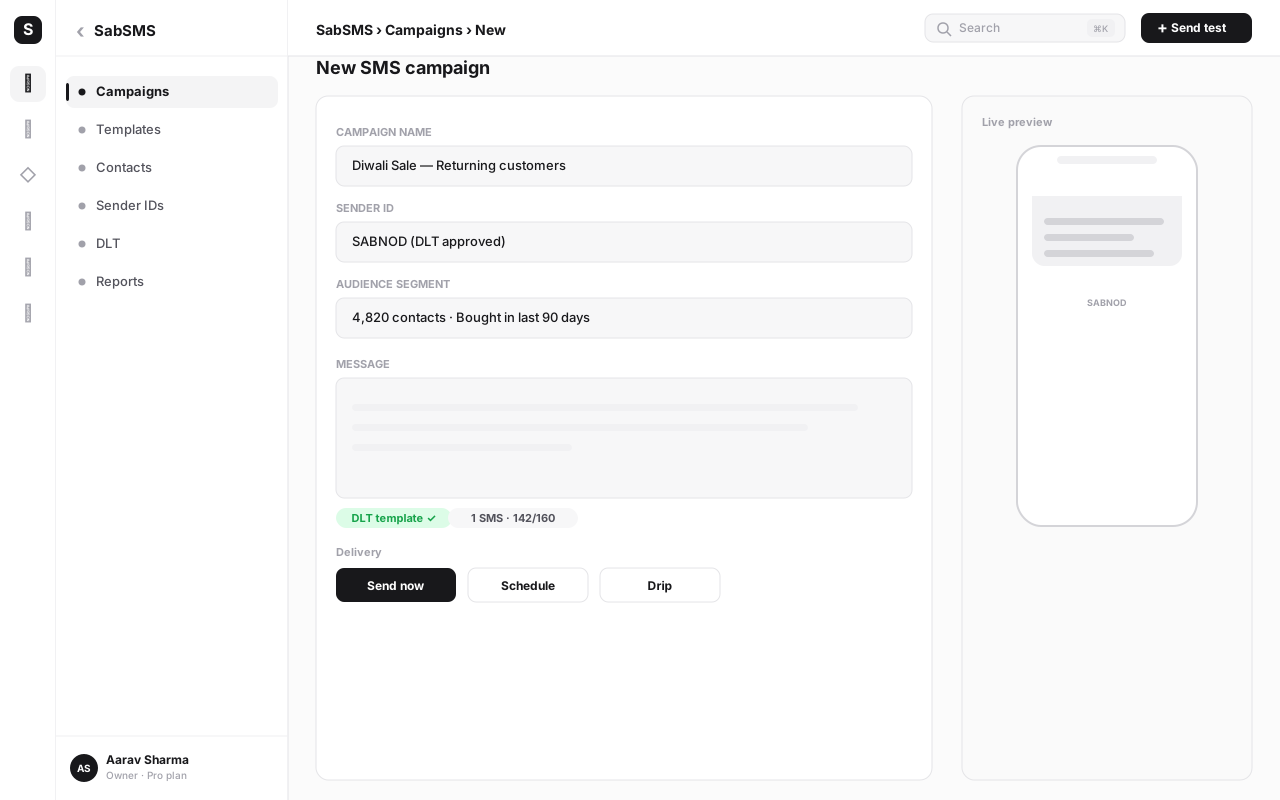
Pros and cons, side by side#
A fair comparison means owning each channel's weaknesses as plainly as its strengths.
When to use which: a decision framework#
Stop asking "which channel is better" and start asking "what is this specific message?" Here's the rule of thumb that resolves almost every case.
Reach for SMS when:
- You're sending an OTP, 2FA code or authentication message. Instant, any-hour, any-network delivery with no app dependency is non-negotiable here, and SMS is the gold standard.
- The message is a critical, time-sensitive alert — payment confirmation, fraud warning, appointment-in-an-hour reminder — that must land regardless of DND or whether the recipient has WhatsApp.
- Your audience is phone-only — you have a number but no WhatsApp opt-in, or the contact is likely on a feature phone or low-data connection.
- Guaranteed delivery outweighs everything else and the content is simple enough to fit plain text.
Reach for WhatsApp when:
- You're running conversational marketing — promotions, new-arrival announcements, re-engagement — that benefits from an image, a button and the ability for the customer to reply.
- The message involves a product or catalog the customer should see and browse, not just read about.
- You're providing customer support or handling an exchange that's naturally a back-and-forth — order queries, returns, bookings.
- You want rich, tappable journeys — cart recovery with a one-tap "Complete purchase," order tracking with a live "Track" button, appointment management with quick-reply confirm/reschedule.
Use both, intelligently sequenced, when:
- You send WhatsApp-first with SMS fallback — attempt the richer WhatsApp message, and if it can't be delivered (no app, offline, no opt-in), fall back to SMS so the message still lands.
- You run a multi-step journey — for example, a marketing promotion over WhatsApp, the resulting OTP over SMS at checkout, and the order-shipped alert over whichever the customer prefers.
This per-message routing is exactly what an omnichannel engagement approach is built to handle — choosing the right channel for each message while the customer record stays unified.
Common mistakes to avoid#
The failures here are predictable, and almost all of them come from treating the two channels as interchangeable.
- Forcing OTPs onto WhatsApp for "consistency." If a customer is offline or hasn't opted in, the code never arrives and they can't log in or pay. Authentication is SMS's job for a reason — don't gamble a checkout on app availability.
- Blasting long marketing copy over SMS. A rich promotion crammed into 160 characters loses everything that would make it convert, and any emoji silently halves your character budget and doubles the cost. If the message wants media, it wants WhatsApp.
- Assuming WhatsApp reaches everyone. It reaches everyone who has the app, is online and has opted in. Build your critical-message plan around SMS's universality, not WhatsApp's conditional reach.
- Running one compliance project and assuming it covers both. DLT does nothing for WhatsApp; Meta approval does nothing for SMS. Set up both regimes if you run both channels.
- Ignoring WhatsApp conversation categories. Sending marketing content under a utility template, or vice versa, gets messages rejected and can hurt your quality rating. Match the category to the content.
- Over-sending on either channel. SMS fatigue and WhatsApp blocks both come from too many irrelevant messages. Fewer, well-targeted sends beat frequent blasts on both channels.
- Keeping the two channels in separate tools. When SMS and WhatsApp live in different systems, you lose the unified customer history, can't do clean fallback, and end up double-paying for overlapping sends. One platform fixes all three.
Running both on one platform#
The conclusion this comparison keeps pointing at is that the smartest businesses don't choose — they orchestrate. SabNode is built for exactly that. WaChat handles WhatsApp Business API marketing, support and catalog, while SabSMS handles DLT-compliant SMS for OTPs, alerts and promotions — and both read from the same contacts.
That shared foundation is what makes the "use both" advice practical rather than aspirational:
- One contact record, both channels. A customer's WhatsApp thread and SMS history sit on the same profile, so nobody gets the same message twice and every interaction is in context.
- Per-message channel choice. Route OTPs to SMS and conversations to WhatsApp by policy, not by manually copying lists between two tools.
- Fallback that just works. Try WhatsApp, fall back to SMS when it can't be delivered — without stitching two vendors together.
- Compliance in one place. Manage DLT headers and templates on the SMS side and opt-in plus approved templates on the WhatsApp side from a single workspace.
For the full picture of how messaging fits alongside CRM, calling and the rest of the stack, see the SabNode platform guide. And to dig into either channel on its own, the WhatsApp Business API guide and the SMS marketing in India guide go deep on each.
Run WhatsApp and SMS from one platform
Start freeConclusion#
WhatsApp marketing versus SMS marketing was never the right question. SMS is a broadcast utility — universal, instant, app-free, the channel you reach for when a message simply has to arrive: OTPs, authentication, critical alerts. WhatsApp is a conversation platform — rich, interactive, two-way, the channel you reach for when the message wants images, buttons, a catalog or a real exchange: promotions, support, conversational commerce. Neither wins outright because they're answering different briefs.
The businesses that get this right stop treating it as a choice. They send the OTP over SMS because it must land, the sale over WhatsApp because it should convert, and the shipping alert over whichever the customer prefers — all from one set of contacts, with one history, under both compliance regimes managed in one place. That's the real verdict: not WhatsApp or SMS, but WhatsApp and SMS, each doing the job it's built for. Compare plans on the pricing page or start free, and route every message to the channel that wins it.
Frequently asked questions
Is WhatsApp marketing better than SMS marketing?
Neither is universally better — they win at different jobs. SMS wins on raw reach and reliability: it lands on every phone with no app, no internet and no opt-in needed for transactional messages, which makes it the default for OTPs and critical alerts. WhatsApp wins on richness and conversation: images, buttons, catalogs and genuine two-way chat that SMS can't match. For most Indian businesses the right answer is to run both on one platform and pick the channel per message.
Which is cheaper, WhatsApp or SMS?
It depends on the message. SMS is billed per message segment (roughly 160 characters), so short alerts are very cheap and long messages cost more per send. WhatsApp is billed per 24-hour conversation by category — marketing, utility, authentication or service — so a single price can cover an entire back-and-forth exchange. For one-shot OTPs SMS is usually cheaper; for an ongoing conversation that would take several SMS, WhatsApp often costs less per outcome. Compare your actual message mix rather than the headline per-unit rate.
Do I need DLT registration for WhatsApp like I do for SMS?
No. India's DLT (Distributed Ledger Technology) framework governs SMS — you register your principal entity, sender IDs and content templates on a DLT portal before you can send. WhatsApp has its own, separate compliance path run by Meta: documented opt-in, an approved WhatsApp Business Account, and Meta-approved message templates with quality ratings. They are two different regimes; running SMS does not satisfy WhatsApp's rules, and vice versa.
Which channel has higher open and response rates?
Both are read far more reliably than email. SMS is famous for being opened almost immediately because it lands directly in the phone's native inbox with no app dependency. WhatsApp tends to drive higher engagement and replies because messages are richer and the channel is conversational — people answer a WhatsApp the way they answer a friend. Exact figures vary by audience and content, so treat 'very high' as the honest takeaway and measure your own numbers.
Can I use WhatsApp and SMS together?
Yes, and that's usually the strongest setup. A common pattern is WhatsApp-first for marketing and conversation, with SMS as the guaranteed-delivery fallback for OTPs and time-critical alerts or when a WhatsApp message can't be delivered. On a platform like SabNode you run WaChat (WhatsApp) and SabSMS from the same contact records, so you can route each message to the channel that fits and see the full history in one place.
When should I use SMS instead of WhatsApp?
Use SMS when delivery has to be guaranteed and instant regardless of app or internet: one-time passwords, two-factor authentication, payment confirmations, fraud alerts and other critical service messages. SMS also reaches numbers where you have no WhatsApp opt-in. Reach for WhatsApp when the message benefits from images, buttons, lists or a real conversation — promotions, catalog browsing, order support and ongoing engagement.